The Month in Question: June 2026
The Month in Question, June 2026: Warsh's first Fed hold, the SpaceX IPO record, the Iran oil shock, and how to defend a view on each in an IB interview.
"What's going on in markets" is not a request for headlines. It's a request for a view you can defend, and the follow-up will take the other side of whatever you say. This is the first edition of a monthly series built for exactly that: four events from the month just closed, each one structured as an interview set piece. What happened, why a banker cares, the two defensible views, the pushback you'll face, and the version you can say out loud in thirty seconds.
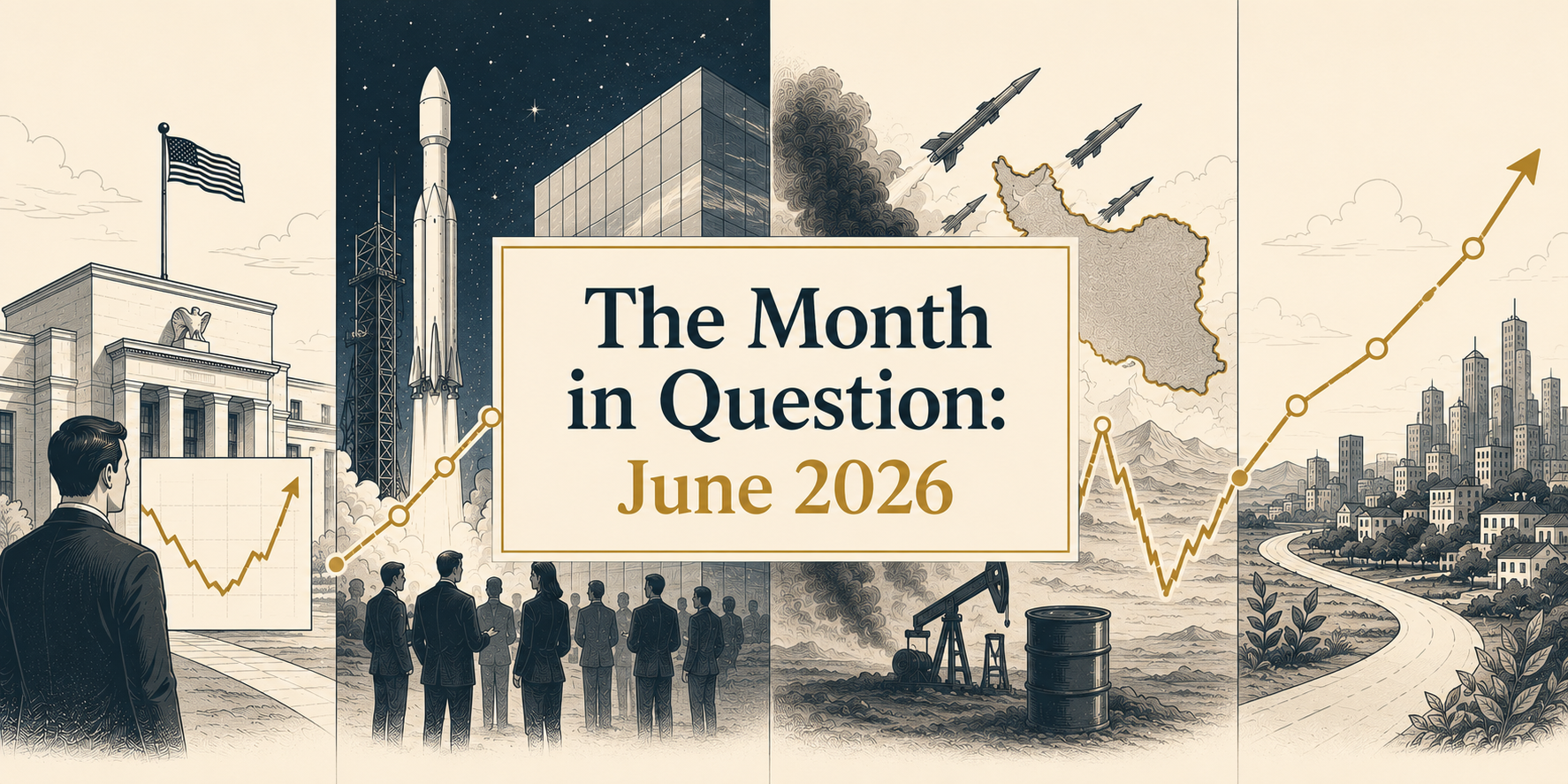
June 2026 was generous. A new Fed chair buried the rate cuts, the largest IPO in history priced into a hawkish tape, a war stayed half-finished, and small caps closed their best first half in decades.
Event 1: Warsh's First FOMC, and the Cuts Became Hikes
What happened. In Kevin Warsh's first meeting as Fed chair, the FOMC held the federal funds rate at 3.50–3.75% on June 17, one week after May CPI showed annual inflation above 4% for the first time in three years. The dot plot was the real event: half the committee penciled in rate hikes for 2026, and by June 30 fed funds markets were pricing roughly a 36% probability of a July hike. Markets no longer expect cuts this year, and research desks that anticipated two 2026 cuts now see none until mid or late 2027. Note the sequencing: Warsh was sworn in on May 22 with the administration explicitly seeking rate cuts, and his first act was to hold.
Why a banker cares. The entire 2026 deal-recovery thesis was underwritten on cuts. Sponsors built pipelines assuming cheaper debt in the second half, that assumption died in June. Every LBO model in the building just repriced its debt schedule, and every DCF's discount rate anchor moved. When financing costs stay at 3.50–3.75% instead of gliding toward 3%, entry multiples have to compress for the same IRR, which widens bid-ask spreads and delays processes.
The two views. View A: the hold is credibility-positive and eventually deal-positive. A chair appointed under pressure to cut, who then holds into a 4% CPI print, has just bought the Fed independence points that anchor long-run inflation expectations, and anchored expectations are what ultimately bring the long end down. View B: higher-for-longer freezes the sponsor bid, pushes exits into 2027, and the dot plot's hike tilt means the pain trade has room to run.
The pushback. Whichever view you take, expect "so when do deals come back?" The defensible answer keys off certainty, not level: deals price when both sides agree on the cost of capital, and a Fed that has clearly stopped moving is easier to underwrite than a Fed that might cut next quarter.
Thirty-second version: "The June FOMC was Warsh's first, and he held at 3.50 to 3.75 a week after CPI crossed 4%. The dot plot flipped the debate from cuts to hikes, with half the committee penciling one in. For our business the level matters less than the repricing: every sponsor pipeline built on H2 cuts just moved to 2027 math."
Event 2: SpaceX Raised $86 Billion, and the ECM Window Blew Open
What happened. SpaceX's June 12 debut raised $86 billion, the largest IPO in history. Alphabet raised nearly $85 billion in a landmark equity offering, and US IPO and secondary share sales topped $250 billion in the first half, a new half-year record. The index mechanics diverged in a way worth knowing: Nasdaq fast-tracked SpaceX into the Nasdaq-100, with index funds set to begin buying in early July, while the S&P 500 declined to make an exception despite the company's $2.2 trillion market cap, leaving its float-adjusted Russell weighting at just 10–15 basis points.
Why a banker cares. Hold this next to Event 1 and you have the best differentiation question of the month: a hawkish Fed and record equity issuance in the same tape. Candidates who treat "rates are high" and "windows are shut" as the same statement fail this one. Equity windows key off earnings confidence and volatility, not the level of the base rate. Issuers sell stock when valuations are defensible and the VIX is quiet, they can do that at a 3.75% funds rate all day. Debt-funded activity is what suffers at these levels, which is why the LBO market and the ECM market told opposite stories in June.
The two views. View A: the window is real and the backlog behind SpaceX is deep, so expect a heavy issuance calendar into the fall while confidence holds. View B: record issuance is itself the warning, since supply of this size historically arrives near sentiment peaks, and the float mechanics (index buyers absorbing paper regardless of price) are masking softer true demand.
The pushback. "If equity is this available, why would anyone sell a company instead of listing it?" The answer is a real dynamic worth naming: a hot IPO market is a competing exit path for sponsors, which pressures M&A sellers' price expectations upward and complicates dual-track processes.
Thirty-second version: "June had the largest IPO ever, SpaceX at $86 billion, plus an Alphabet raise of nearly the same size, and H1 equity issuance set a record above $250 billion. The interesting part is that this happened into a hawkish Fed. Equity windows run on earnings confidence and low volatility, not the base rate, which is why ECM and the LBO market are telling opposite stories right now."
Event 3: The Iran War, the Oil Spike, and the Market That Looked Through It
What happened. The conflict drove sharp increases in energy prices and a notable repricing across asset classes after it began in the late-winter intermeeting period. The 30-year Treasury yield spiked to 5.18% on May 19, its highest in nearly 19 years, on fears of a sustained energy shock. Brent then fell nearly 20% in May as ceasefire optimism grew, even though the Strait of Hormuz remained effectively closed for the entire month. Equities recovered rapidly, and the market bottomed before any concrete roadmap toward reopening the Strait existed. One caveat that must travel with this story: it is priced, not settled. Late June brought renewed strikes on shipping in the Strait and fresh escalation rhetoric, even as an Iran MoU and falling oil prices cooled rate-hike expectations in Europe.
Why a banker cares. Geopolitics hits deal activity through three channels, and naming all three is what separates a candidate from a headline-reader. First, volatility windows: boards don't launch sales into a VIX spike, so processes paused in the spring and resumed as the tape calmed. Second, the inflation channel: the oil spike fed the CPI prints that killed the rate cuts, which means Event 1 and Event 3 are one story, not two. Third, sector divergence: energy coverage had the opposite year from everyone else.
The two views. View A: markets were right to look through it. Transient supply shocks without sustained economic disruption don't change discounted cash flows, and the speed of the recovery is the discipline working as intended. View B: markets are underpricing tail risk. The Strait stayed closed for a month, the ceasefire is a memorandum rather than a settlement, shipping was being struck again in late June, and an equity market near record highs carries no risk premium for re-escalation.
The pushback. The embedded trap is the question itself: "does geopolitics matter for markets?" Yes and no are both wrong. The defensible answer is conditional: it matters when it produces sustained economic disruption, and gets looked through when it doesn't. State the condition rather than picking a side, because the condition is the judgment the question exists to test.
Thirty-second version: "Oil spiked when the conflict threatened the Strait, the 30-year hit its highest yield in nearly two decades in May, and then most of the premium unwound on ceasefire momentum before any concrete reopening existed. The market's rule showed up again: geopolitics reprices assets when it disrupts the real economy in a sustained way, and gets faded when it doesn't. I'd just flag that this one is priced rather than settled."
Event 4: The Rotation, and Small Caps' Best First Half Since 1991
What happened. The S&P 500 declined modestly in June while equal-weight and small-cap benchmarks advanced, and within the AI trade semiconductors stayed strong while the hyperscalers funding the buildout pulled back. The headline stat: the Russell 2000 hit a new all-time high and gained more than 21% in the first half, its best first six months since 1991.
Why a banker cares. Broadening leadership is a mid-market deal signal. When small caps re-rate, take-private math gets harder for sponsors (the same target now costs two more turns), but strategic sellers who were stuck below their own price expectations get unstuck, and IPO candidates outside mega-cap tech get a window they haven't had in years. The AI divergence carries a second thread: earlier in the year, AI-disruption concerns hit software business models hard enough that leveraged loan prices for software issuers fell sharply and several private credit funds saw elevated redemption requests. If AI genuinely erodes seat-based software economics, the collateral behind a large stock of software LBO debt reprices, which is the Citrix vintage's underwriting assumptions being retested in real time.
The two views. View A: the rotation is healthy and durable, driven by real earnings breadth, and it marks the start of a multi-year small and mid-cap cycle. View B: it's late-cycle churn, capital rotating within an expensive market rather than new money validating fundamentals, and the software-credit stress is the early warning worth weighting more than the Russell print.
The pushback. "Which side of the AI trade would you rather cover right now?" There's no safe answer, only a structured one: semis are where the earnings are today, software is where the repricing risk sits, and the honest position names both before picking.
Thirty-second version: "The index story in June was rotation: the S&P slipped while equal-weight and small caps advanced, and the Russell 2000 finished its best first half since 1991. For deal flow that cuts both ways. Sponsors face richer take-private math, but stuck strategic sellers come unstuck, and the mid-cap IPO window reopens. The thread I'd watch is software credit, where AI-disruption fears already hit leveraged loan prices earlier this year."
How to Run Any of These in the Room
The delivery protocol is the same every month. Punchline first, one mechanism, one honest counterargument, stop. When the interviewer takes the other side, and they will, hold the view, engage their specific objection rather than repeating yourself, and name what evidence would change your mind. Folding instantly signals you never held the view. Digging in blindly signals you can't update. The calibrated middle is the entire test.
Where to Drill
Business Acumen / Markets is one of the eleven question categories in every HARDO session, at all three tiers. The Analyst-level interviewer does what the exchange above shows: it takes the other side of whatever view you bring and scores the response, not the opinion. If you want these four events stress-tested before someone does it for real, one Intern interview is free and takes twenty minutes.
Reading is reps. Now take the rep.
Drill this in a mock- Market BriefThe Month in Question: July 2026
The Month in Question, July 2026: the Fed's 9-3 split, the Getty-Shutterstock collapse, Sky's ITV deal, SpaceX in the index, and how to defend each view.
- Live Deal ExamplesThe $3.7 Billion Merger That Died a Month After Being Approved
Getty and Shutterstock's $3.7B merger died after the CMA approved it. The remedy math, the break mechanics, and the financing unwind, for IB interviews.
- Knowledge HubEnterprise Value vs Equity Value: The Questions Behind the Bridge
Enterprise value vs equity value, past the memorized bridge: the one principle, the multiple-pairing rule, and the edge cases interviewers test.