The Three-Statement Questions That Open Every IB Technical Interview
The three-statement questions that open every IB interview - the four patterns behind all of them, and the follow-ups that kill prepared candidates.
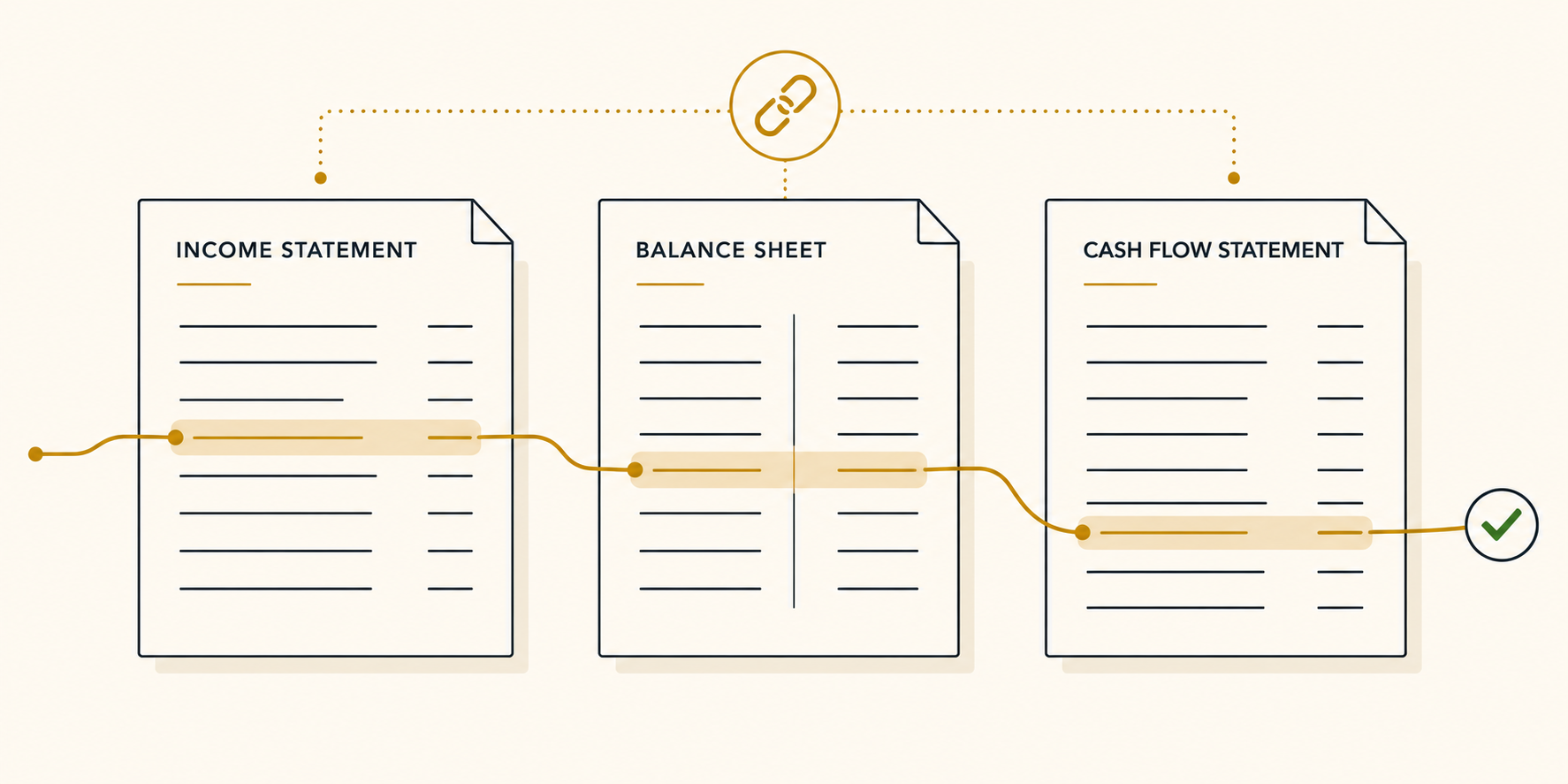
Before anyone asks you about a DCF or an LBO, they ask how the three statements link. It's the first technical question in most first-rounds, and it's a hard gate. Fail it and the rest of the interview is a formality conducted out of politeness.
Most candidates prepare for it the wrong way. Prep guides teach the topic as a question list: twenty questions, twenty memorized scripts. Interviewers read the same guides, and they've learned that changing one input makes the script collapse. Memorization is exactly what the question is designed to detect.
There's a better approach. Every accounting interview question is one of four patterns. Learn the four patterns, three checkboxes, and one delivery move, and you can answer questions you've never seen. That is the skill actually being tested.
The Three Checkboxes in the Interviewer's Head
Start from the scorer's side, because almost no candidate knows what's being graded.
When an interviewer asks you to walk through $10 of depreciation, they're listening for three things.
Did you state your tax rate assumption before starting? Not because the number matters, but because stating assumptions before computing is the habit of someone who has built models under review. The candidate who launches into the walk without naming a rate is the candidate whose model the associate will have to audit line by line.
Did you name the tax shield mechanism unprompted? Anyone can recite that cash goes up $2.50. Candidates who clear the question say why: depreciation is non-cash, but the tax saving it generates is real cash. That sentence separates understanding the linkage from having memorized one path through it.
Did you say the balance check out loud? "Assets are down $7.50, retained earnings is down $7.50, the balance sheet balances." Five seconds. Skipping it signals you don't verify your own work, and verification is most of what a first-year analyst is paid to do.
Most candidates hit zero of three. They deliver a technically correct walk and wonder why the interviewer looked unimpressed. The walk was never the whole test.
The Statements in One Minute
The income statement measures performance over a period on an accrual basis: revenue when earned, expenses when incurred, regardless of when cash moves. The balance sheet is a snapshot at a point in time, governed by one identity: Assets = Liabilities + Equity. The cash flow statement reconciles them. It starts from net income, unwinds every accrual assumption the income statement made, and ends at the actual cash in the bank.
Three linkages carry every answer. Net income flows to retained earnings and to the top of the cash flow statement. Non-cash charges hit the income statement and get added back on the cash flow statement. The cash flow statement's ending cash is the balance sheet's cash line.
Underneath all of it sits one idea: the gap between accrual and cash. Every question in this category is, at bottom, a question about that gap.
The Universal Solver
Here is the algorithm that replaces the question list. It answers any transaction question in three steps:
1. IS test: does the transaction hit the income statement?
   If yes -> compute the after-tax net income impact.
   If no  -> skip to step 2.

2. CFS: start from the change in net income, reverse any
   non-cash items, place the cash movement in the right
   section (operating, investing, or financing).

3. BS: pull ending cash from the CFS, adjust the affected
   line items, plug retained earnings with the NI change,
   say the balance check out loud.
The IS test is where you separate from the memorizers. Roughly half the questions in this category have no income statement impact at all: inventory purchases, deferred revenue, CapEx, debt raises. A candidate who reflexively starts every answer at the income statement has failed those questions before saying a number.
The Canonical Question, Answered Punchline-First
"Walk me through $10 of depreciation on the three statements."
Before the walk, a delivery move no prep guide teaches: answer first. Experienced bankers respond with the conclusion, then the support. It signals command instantly, and it protects you if you get interrupted mid-walk.
"Assuming a 25% tax rate, cash ends up $2.50 higher. Here's the walk."
Then the statements:
IS:  Pre-tax income -10 -> tax savings +2.50 -> net income -7.50
CFS: Start at -7.50, add back depreciation +10 -> cash +2.50
BS:  Cash +2.50, PP&E -10 -> total assets -7.50
     Retained earnings -7.50 -> balances
And the sentence that hits checkbox two: cash rises even though earnings fall, because depreciation never touched cash but the tax shield it created is real money.
One trap to know before you drill this. Older prep guides, and many scripts still circulating on forums, use a 40% tax rate, a rounding of the pre-2018 US federal-plus-state burden. The federal rate has been 21% since the 2018 tax reform; roughly 25% effective is the modern convention. Neither number is wrong. But if you drilled at 40% and your interviewer is doing mental math at 25%, your numbers silently diverge from theirs mid-answer. Stating the assumption up front is what keeps that divergence from reading as an error.
The Four Patterns
Every question in this category is one of four transaction types.
Non-cash income statement items
Depreciation, stock-based compensation, impairments, amortization. IS hit, CFS add-back, balance sheet plug. Depreciation above is the template.
Stock-based compensation carries a wrinkle, and it's the reason interviewers reach for it after you've cleared depreciation. $10 of SBC at 25%: net income falls $7.50, the CFS adds back the full $10, cash rises $2.50. But nothing happens to PP&E. The offset is a $10 increase in additional paid-in capital, inside equity. Cash is up $2.50 on the asset side, and equity is up $2.50 net (APIC +10, retained earnings -7.50). SBC is the one item in this pattern where the plug isn't an asset.
Working capital moves with no income statement impact
Inventory, receivables, payables, deferred revenue. This is the reflex-breaker: nothing has been earned or incurred, so the income statement is silent, and a candidate who starts there has already revealed the memorization.
Inventory rises $10, paid in cash. No IS impact, because nothing was sold. On the CFS, a $10 working capital use in operating; cash down $10. On the balance sheet, inventory up $10, cash down $10, total assets unchanged.
Deferred revenue is the same pattern inverted, and the purest accrual-versus-cash question in the bank. Collect $100 upfront for a service not yet delivered: zero revenue recognized, cash up $100, deferred revenue liability up $100. The company holds cash it hasn't earned, which is precisely what the liability records.
Investing transactions
CapEx and asset sales. $100 of CapEx: no income statement impact at purchase. The expense arrives later, spread over years as depreciation. Cash down $100 in investing, PP&E up $100. The question tests one distinction: capitalization versus expensing. Money spent on an asset with a multi-year life goes to the balance sheet first and reaches the income statement gradually.
The asset-sale variant has a trap sharp enough that it gets its own treatment below.
Financing transactions
Debt raises, buybacks, dividends. Raise $100 of debt: no income statement impact at the moment of the raise. Interest comes later, in future periods. Cash up $100 in financing, debt up $100. The test here is temporal. Candidates who put interest expense into the year-zero answer are compressing time, and interviewers notice.
Whatever transaction question you get, it's one of these four. Run the IS test, identify the pattern, execute the solver.
The Three Follow-Ups That Kill Prepared Candidates
Prep articles stop at year one of the base question. Interviews don't.
"Now walk me through year 2." The effects compound. Another $10 of depreciation in year two means another -$7.50 to net income and another +$2.50 to cash. But the balance sheet is cumulative: accumulated depreciation now sits at $20, cash is up $5.00 total, retained earnings is down $15.00 total. Assets down $15.00, equity down $15.00, balances. Candidates who fail this restate the year-one answer, because their script only had one year in it.
The asset sale with a gain. "You sell PP&E with a book value of $80 for $100 in cash." The IS shows a $20 gain, taxed at 25%: net income up $15. Now the trap. The full $100 of proceeds goes in investing. But the $20 gain must be subtracted in operating, because the gain is already sitting inside net income at the top of the CFS and the full proceeds are in investing. Without the subtraction you count $20 of the sale twice. Operating: +15 net income - 20 gain = -5. Investing: +100. Net cash +95, which is exactly right: you received $100 and paid $5 of tax on the gain. Balance sheet: cash +95, PP&E -80, assets up $15, retained earnings up $15. This subtraction is where even well-prepared candidates crack. It's the one place in the category where a number gets removed from operating cash flow rather than added back.
The mid-answer input switch. "Okay, make it $20 of depreciation and a 30% tax rate." This tests composure, not arithmetic. Do not restart the walk. Restate the punchline with scaled numbers ("then net income falls $14, the add-back is $20, and cash ends up $6 higher") and re-walk the statements only if asked. Restarting from the top signals you can only execute the script from its first line. Jumping straight to the new punchline signals you're computing, not reciting. The switch is the interviewer's cheapest memorization detector, which is why it arrives without warning.
The Two Classics
Two follow-ups travel with this territory often enough to prepare directly.
"If you could only have one statement, which one?" The canonical answer is the cash flow statement: cash is the closest thing to economic reality and the hardest number to manipulate. The upgraded answer adds a caveat. For a moment-in-time solvency question you'd want the balance sheet instead, because the CFS describes a period and solvency is about a position. The caveat shows you understand that the statements answer different questions, which is the actual point of the exercise.
"Can a company have positive net income and still go bankrupt?" Yes. The mechanism is cash timing: receivables that never collect, working capital consuming cash faster than accrual earnings generate it, a debt maturity that can't be refinanced. Profitable on paper, illiquid in fact. Net income is an accrual opinion. Cash is a fact. Companies die of cash.
The 90-Second Sample
The full model answer for the canonical question, checkboxes marked:
"Assuming a 25% tax rate [assumption stated], cash ends up $2.50 higher. Here's the walk. [Punchline first.] On the income statement, pre-tax income falls $10, taxes fall $2.50, so net income is down $7.50. On the cash flow statement, I start at negative $7.50 and add back the full $10 of depreciation because it's non-cash, so cash is up $2.50. Depreciation itself never touched cash, but the tax shield it created is real money. [Tax shield, unprompted.] On the balance sheet, cash is up $2.50, PP&E is down $10, so total assets are down $7.50. Retained earnings is down $7.50 through net income. Assets down $7.50, equity down $7.50. The balance sheet balances." [Check said aloud.]
Roughly forty-five seconds spoken. All three checkboxes hit, and because the punchline came first, the answer survives even if the interviewer cuts in after the first sentence.
Where to Drill
The Intern-level interviewer on HARDO works this exact territory: the four patterns, the base questions, the classics. The Analyst-level interviewer is where the follow-ups in this article live. It changes inputs mid-answer, pushes into year two, and reaches for the gain-on-sale trap when the base walk comes back too clean. The solver is the method. Reps against an interviewer that switches inputs without warning are how it becomes reflex.
Reading is reps. Now take the rep.
Drill this in a mock- Knowledge HubEnterprise Value vs Equity Value: The Questions Behind the Bridge
Enterprise value vs equity value, past the memorized bridge: the one principle, the multiple-pairing rule, and the edge cases interviewers test.
- Knowledge HubHow to Answer Due Diligence Questions in an Investment Banking Interview
Due diligence is the IB interview category with no formula. What QoE reports actually check, the working capital peg, and how to prioritize red flags.
- Knowledge HubHow to Handle an IB Interview Question You Didn't Prep For
Investment banking interviews always include a question you didn't prep for. How to handle the miss without bluffing, freezing, or surrendering.