First-Round vs Superday: What Actually Changes
First-round and superday are not the same interview at harder difficulty. What actually changes between them, and how to prep for each
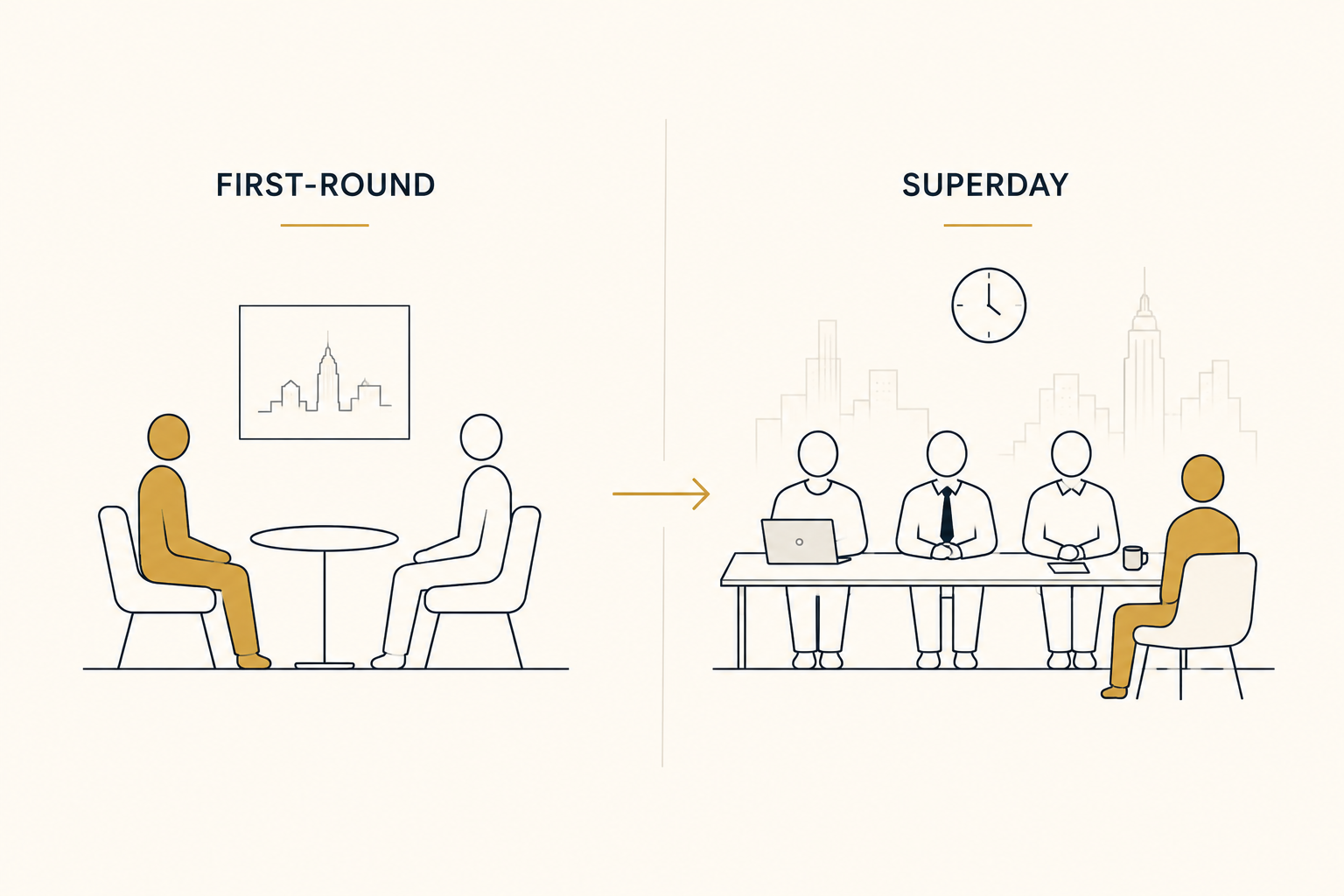
Most candidates treat first-round and superday as the same interview at higher difficulty.
They're not. They test different things, with different formats, different stakes, different interviewer profiles. The candidate who preps for the superday like a harder first-round walks in unprepared for the actual evaluation that happens. The candidate who understands the structural differences shows up with the right answers for the right room.
This piece walks what actually changes between the two stages: format, interviewer seniority, depth of questions, the deal expectation, the fit dimension, stamina, and the cross-interviewer dynamic that decides who gets the offer.
Format and Logistics
First-round is usually thirty minutes, virtual (Zoom, sometimes a HireVue asynchronous video where you record yourself answering pre-set questions), one on one. You can do it from your dorm room between classes. Camera on, dress shirt visible, headphones in, twenty-eight minutes of conversation and then it's over. You eat lunch. The interviewer moves to the next candidate. Decisions get made in a feedback database within a few days.
Superday is in-person at the bank's office. Some banks ran hybrid superdays during the pandemic, but in-person is back as the standard. You take a flight in (the bank usually pays for it for target schools, sometimes for non-targets too), you sleep in a hotel the night before, you show up at the bank's lobby at 8:30 AM. Four to six interviews back to back, sometimes a lunch or coffee in between, total session three to five hours. You're at the bank's office, in the bank's environment, walking past the trading floor and the boardroom on the way to the next interview room.
The format difference is itself a test. The bank wants to see whether you can show up at their office, dressed properly, present and focused, perform under pressure for half a day, and not crumble. The infrastructure of the day, the formality of the building, the dress code, the fact that you're being escorted between rooms by an HR coordinator who's also watching how you behave, all of it is part of the evaluation. The first-round doesn't have any of that texture. The superday is texture-heavy.
Who's Interviewing
First-round interviewers are usually analysts (two to three years out of undergrad), associates (five to six years), or junior VPs. They're screening on behalf of the team. Their feedback matters, but they aren't the deciders. The first-round interview is a filter, run by people whose job it is to filter.
Superday interviewers include senior bankers: MDs, group heads, sometimes the head of investment banking division for the region. The MD's view in the post-superday meeting is often the deciding factor on who gets an offer.
The interviewer mix matters because juniors and seniors interview differently. Juniors stick closer to the script. Walk me through the resume. Why IB. Why this bank. Walk me through a DCF. They've been trained on the standard question battery, they ask the standard questions, they're scoring you against a rubric that lives in their head.
Seniors go off-script. Open-ended questions. Sector takes. Judgment tests. What MDs call "intangibles." A twenty-year MD has interviewed five hundred candidates and is testing for things you can't anticipate from a prep guide. They might ask you about something happening in the market that morning. They might ask you what you'd do if you were CEO of a company in the news. They might just talk to you for twenty minutes about your hometown and read the energy. The questions aren't the test. The conversation is the test.
What's Being Tested
First-round is a floor test. Can you walk through your resume coherently. Can you articulate why banking with at least one specific reason. Can you do the basic technical work (DCF, accretion, EV bridge, comps at a surface level). Can you hold a thirty-minute conversation without saying anything weird. The bar is "competent and not weird."
Superday is a top-of-cohort test. Multiple interviewers are comparing you to other candidates who all cleared the floor. The bar is "in the top few who came through today." The differentiating factors are depth, judgment, and fit, not whether you got the basics right. Getting the basics right is assumed.
The implication is the one most candidates miss. If your first-round answers were good enough to advance you to the superday, those same answers won't be good enough at the superday. You need a level deeper on everything. The candidate who recycles their first-round prep into the superday is the candidate who gets dinged for being underprepared, often without realizing they were underprepared. They thought they were ready. They were ready for a different test.
The Depth of Follow-Ups
First-round questions tend to be one or two layers deep. "Walk me through a DCF." You walk through it. "Sounds good." Move on. "Why investment banking." You give your anchored answer. "Got it." Move on.
Superday questions go three or four layers. "Walk me through a DCF." You walk through it. "Why unlevered FCF, not levered." You answer. "Walk me through how you'd calculate WACC for a private company." You walk through. "What's the implied capital structure assumption in your peer-derived beta." Now you're at layer four, and most candidates collapse here because they prepped at layer one.
The same depth happens on behavioral. "Why investment banking." You give your anchored answer. "Why not consulting." You give the why-not-consulting answer. "Okay, but my old college roommate is a partner at McKinsey and he says the same things about consulting that you're saying about banking, what makes you sure you've got the right read." Now you're at layer three of a behavioral question, and most candidates haven't prepped for layer three, because their prep stopped at the polished first answer.
The fix is to prep at layer four. Every technical answer in your stack should have four layers of follow-up behind it, with specifics ready for each layer. Every behavioral answer should have a real example, a real consequence, and a real reflection on what it taught you. The earlier articles in this series on DCF, LBO, accretion, comps, and premium analysis are pitched at the layer-four level for exactly this reason. If you've worked through them at depth, you have the muscle. If you've skimmed them, you don't.
The Deal Question
First-round: deals are rarely asked. If they come up, it's "are you following any deals," and a brief generic answer is acceptable. The interviewer mostly wants to confirm you're not completely out of touch.
Superday: deals are not optional. "Walk me through a recent deal you find interesting." This is one of the highest-leverage questions in the whole superday, because it tests four things at once. Sector awareness, can you talk about an actual transaction in a sector relevant to the group. Judgment, can you say something analytical about why the deal happened, not just what happened. Communication, can you structure a multi-minute walkthrough without losing the interviewer. Genuine interest in the work, are you actually following the industry or just reading prep guides.
The Microsoft / Activision article earlier in this series is the template for what a deal answer should look like at superday level. Knowing one deal at four-layer depth beats knowing five deals at surface depth. Pick one. Learn the rationale, the valuation, the financing, the regulatory journey, the integration, the advisor lineup. Run it as your set piece. When the interviewer asks "tell me about a recent deal," you have ninety seconds of structured walkthrough ready, and four follow-up questions deep on every piece of it.
The candidates who do this stand out immediately. Most candidates can name a deal. Very few can talk about it for ten minutes with depth and a point of view. The few who can are the ones who get offers.
The Fit Dimension
First-round: minimal. The interviewer assesses whether you can hold a conversation and seem like someone who would survive on the team. Thirty minutes is barely enough for a fit read.
Superday: heavy. Multiple interviewers are asking the same implicit question across five separate conversations. Would I want to be in a cab with this person at 2 AM after a closing dinner. Would I trust them with a client. Would I want them on my deal team next month. Would I be okay with this person sitting next to me for eighteen months.
The fit dimension is hard to prep for because it's not about answers, it's about presence. The candidates who try to perform "fit" usually fail because the performance reads as inauthentic across multiple interviewers. By the third interview, the rehearsed enthusiasm and the practiced laugh start to feel forced, and the senior banker who's run a hundred superdays notices.
The harder fix is the real one. Be someone the bankers would actually want to work with. That means being curious, asking questions back when the conversation invites it. Engaged, leaning forward, eye contact, treating the interviewer like a person you're interested in rather than an obstacle to clear. Calibrated about your own capabilities, willing to acknowledge what you don't know rather than bluffing. Unbothered by ambiguity, comfortable when the interviewer goes off-script. None of those can be faked across five interviewers in a row. The fakers get caught somewhere between interview two and interview four, and the post-superday debrief surfaces it.
Stamina
Thirty minutes versus three to five hours.
In the first-round, you can hit peak performance for the whole interview because the interview is short. The single highest-energy version of you is what shows up. You can be on for half an hour without much practice. Most candidates can.
In the superday, you can't. Your fifth interview will be judged against your first, and most candidates fade. The drop is real and predictable. Energy management matters. Eat before the day starts, something with protein, not just a banana. Hydrate, but not so much that you're constantly looking for a bathroom between interviews. Don't load up on coffee at the start. The crash hits at the second-to-last interview, which is usually the most senior one, and the crash is visible. One cup at the start, maybe one mid-morning, no more.
Know that the post-lunch slot is the hardest of the day for staying sharp. Most superdays schedule the lunch around 12:30 or 1, and the 2 PM interview catches almost every candidate at their lowest energy point. If you know the slot is there, you can prepare for it. Walk briskly to the room. Take a deep breath in the doorway. Force the energy up by twenty percent in the first thirty seconds of the conversation. The first impression in the post-lunch slot sets the tone for the whole interview.
Senior bankers know about the fade. The MD who interviews you at hour four is partly testing whether you can hold it together when you're tired, because the same skill matters at hour fourteen of a live deal. Showing up sharp at hour four is itself a credential. The candidates who fade in the last interview lose to the candidates who didn't, even if the candidates who didn't were no sharper at hour one.
The Cross-Interviewer Signal
First-round: one interviewer's read decides if you advance.
Superday: interviewers compare notes immediately after the day, often before the candidate has left the building. They look for consistency. The candidate who showed up differently to each interviewer gets flagged. The candidate who showed up the same way to all of them, with the same level of energy, the same answers, the same level of detail, is the one who clears.
The implication is counterintuitive. Don't try to read the interviewer and tailor your answers to who you think they want you to be. Show up as yourself, then repeat. The senior MD will compare notes with the junior analyst after, and if the analyst says you were enthusiastic and engaged, and the MD says you were checked out and rote, the inconsistency itself ends the conversation regardless of which read was "right." The team can't trust a candidate they can't predict.
The same principle applies to your factual answers. If you tell the analyst you've been reading a specific industry publication and tell the MD you've been reading a different one, both true, both fine in isolation, the inconsistency lands as something else when they compare notes. You sound like you're telling each interviewer what you think they want to hear. The fix is to pick the things you actually do and stick to them across all five interviews. The cleanest answer is the same answer to everyone.
The Networking Factor
First-round: networking matters for getting the interview. The bankers you've spoken to put your resume on the table during the candidate selection meeting and advocate for the interview slot.
Superday: networking matters again, this time for the offer decision. After the superday, the team meets and discusses each candidate. Notes get compared. Strengths and concerns get listed. The MD who's met you twice for coffee chats has a reason to advocate for you in the room. The MD who hasn't doesn't. Quiet supporters in the room are what turn marginal candidates into offers, and the supporters are built before the superday, not during it.
The most underrated piece of networking is the post-superday touch. The thank-you note matters, the follow-up email a week later matters, the reminder you exist between offer announcement and acceptance matters. Candidates who treat networking as a pre-interview activity miss the part where networking is also a post-interview activity.
If you don't get the offer, the same network you built is what you use for the next cycle. The MDs who interviewed you at one bank may move firms or refer you to colleagues elsewhere. The relationship outlives the specific recruiting outcome.
How to Calibrate Your Prep
Pulling it together. Different sections of your prep stack matter at different stages.
For first-round, nail the floor. The resume walkthrough, the why IB anchor, basic technicals (DCF structure, accretion / dilution mechanics, EV bridge, comp set selection), why this bank with one specific reason. The articles on the three first-round questions and the resume walkthrough in this series are the templates. If you can deliver those at speed and depth, you'll clear the floor at most banks. Some banks will go deeper than first-round usually warrants, but the floor coverage handles the median first-round screen.
For superday, layer depth onto everything. The technicals get harder. The behavioral gets weirder. The deal question is unavoidable. Fit becomes the differentiator. Stamina is a real constraint that no amount of technical depth compensates for.
The two-line version of the prep difference. If first-round prep is the foundational article in this series on the three questions, superday prep is every technical article plus the deal example plus the behavioral deep dives plus a stamina plan. The base is the same. The depth requirement is different by an order of magnitude.
The candidates who fail the superday after clearing the first-round are almost always candidates who didn't recalibrate. They walked in with first-round prep and ran into superday questions. They had the floor answers but no layer-four depth. They had a generic why-IB anchor but no defense against the why-not-consulting follow-up. They could walk through a DCF but couldn't defend their terminal growth rate against an MD who's been pricing perpetuity assumptions for fifteen years.
The Sample Superday Day
A model for what a superday looks like in practice.
8:30 AM, arrive at the bank's lobby. HR coordinator greets you, takes you to a waiting area. Other candidates may be in the same room. Don't compare prep notes. Stay focused.
9:00 AM, interview one, with an analyst or associate. Technical heavy. Walk me through a DCF. Walk me through an LBO. Basic comps questions. Lasts thirty to forty-five minutes.
9:45 AM, interview two, with an associate or VP. Behavioral heavy. Walk me through your resume. Why IB. Why this bank. Tell me about a time you failed. The "would I want to work with this person" assessment is happening underneath the surface questions.
10:30 AM, interview three, with a senior VP or principal. Mixed. The deal question shows up here. "Tell me about a recent deal you've been following." This is where the Microsoft / Activision style set piece earns its place.
11:15 AM, brief break. Coffee. Bathroom. Do not check your phone obsessively, do not call your friends to debrief on the morning. Stay in the building's energy.
11:30 AM, interview four, with an MD. Off-script. Open-ended questions. Sector takes. "What do you think is going to happen in [recent industry development]." Judgment test. The MD is reading you as much as they're testing your answers.
12:15 PM, lunch with associates or VPs. This is also an interview. Smaller talk on the surface, but the bankers at the lunch are reporting their read of you back to the team. Eat lightly. Don't drink. Be interested in the people across from you.
1:30 PM, interview five, with another MD or group head. The hardest interview of the day for most candidates because it's post-lunch and it's senior. The energy management you've planned for matters here.
2:15 PM, interview six, with a senior banker or sometimes the head of recruiting. Fit-heavy. By this point the team has formed an early read on you and is calibrating final questions.
3:00 PM, you're done. HR walks you out. They tell you when to expect a decision (usually within a week, sometimes the same day for top candidates).
The model isn't universal, banks vary, but the shape holds. Five to six interviews, escalating seniority, mixed technical and behavioral, lunch as a hidden interview, senior MD slot somewhere in the back half.
Where to Drill
The Intern-level interviewer on HARDO is the floor test, calibrated to first-round level questions and pace. The Analyst-level interviewer is calibrated to the depth that superday requires, with multiple layers of follow-up on every technical and the deal walkthrough as a forced set piece. The transition from first-round prep to superday prep is mostly about layering depth onto the same fundamentals, not learning new ones. The candidates who walk into superday with first-round prep are the ones who get dinged. The candidates who walk in having pushed every answer to layer four are the ones who get offers.
Reading is reps. Now take the rep.
Drill this in a mock- Knowledge HubEnterprise Value vs Equity Value: The Questions Behind the Bridge
Enterprise value vs equity value, past the memorized bridge: the one principle, the multiple-pairing rule, and the edge cases interviewers test.
- Knowledge HubThe Three-Statement Questions That Open Every IB Technical Interview
The three-statement questions that open every IB interview - the four patterns behind all of them, and the follow-ups that kill prepared candidates.
- Knowledge HubHow to Answer Due Diligence Questions in an Investment Banking Interview
Due diligence is the IB interview category with no formula. What QoE reports actually check, the working capital peg, and how to prioritize red flags.