The Weakness Question, Without Sounding Coached
In an investment banking interview, the weakness question kills more candidates than the technicals. Why rehearsed answers fail, and how to fix yours.
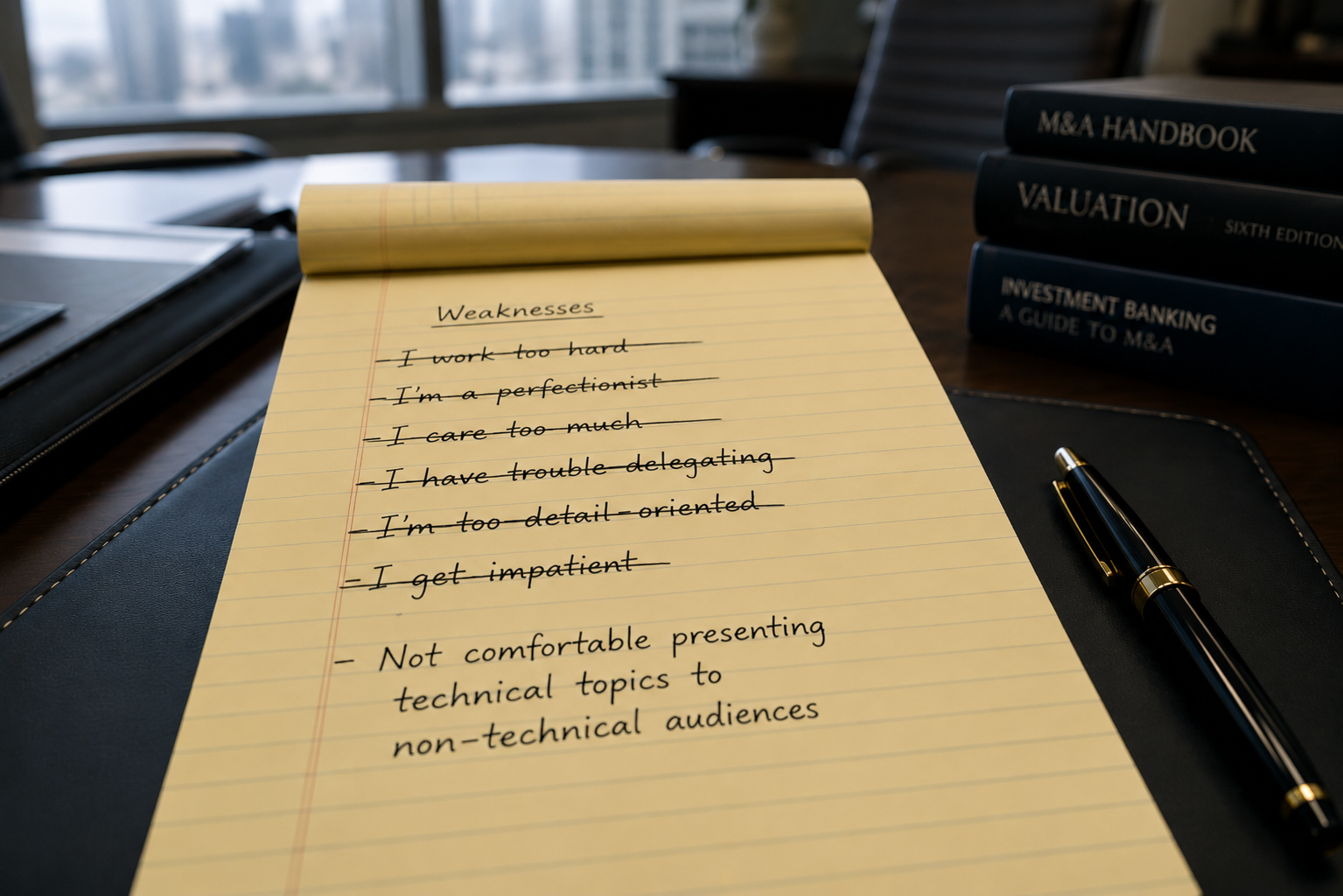
The weakness question is the one most candidates think they've solved.
They have an answer ready. They've practiced it. They've recorded themselves on Zoom. They've run it past career services and a friend who works at a bank. They walk into the interview confident. And the moment they deliver it, the interviewer mentally checks out, because the answer they prepared is the same answer 80% of candidates prepare.
"I'm a perfectionist." "I struggle with work-life balance." "I take on too much." Every recruiter has heard each of these forty times this month. Every banker has a private taxonomy of which clichés signal which type of unprepared candidate. The clichés are not borderline acceptable. They are dead on arrival, because the interviewer has already mentally moved you into the "rehearsed" pile by the time you finish the sentence.
The weakness question isn't asking about your weakness. It's asking whether you have the self-awareness to give an answer that isn't a script. This piece walks how to answer it honestly, in a way that signals what interviewers are actually screening for, without sounding like the eighty other candidates they screened this week.
What This Question Is Actually Testing
Interviewers don't ask the weakness question because they want to identify weaknesses. The question itself is a screening tool, not a diagnostic one. They're testing four things at once.
Self-awareness. Can you diagnose yourself accurately. Do you know where your gaps are, or are you operating with an inflated sense of your own capability. This is one of the most important predictors of how someone performs as a junior banker, because the work generates constant signals about what you're doing wrong and you have to be able to receive them.
Honesty. Will you say something real, or will you hide behind a script. The interviewer is not naive. They know the prep guide answers. They've seen the templates. When you deliver the template, you're signaling that you didn't trust the interviewer enough to give a real answer, which is itself a problem.
Coachability. When you find a weakness, do you work on it. Or do you notice the gap and continue without engagement. The follow-up questions are how the interviewer tests this. Saying "I'm working on it" without specifics doesn't survive the next thirty seconds.
Mature relationship with imperfection. Do you treat your mistakes as failures, as data, or as something to hide. The candidates who treat imperfection as data are the ones who improve over years. The candidates who treat it as failure burn out. The candidates who hide it get fired.
The candidates who answer this question well aren't the ones with the cleverest answer. They're the ones whose answer sounds like a real person describing a real thing they're working on.
The Answers That Don't Work, and Why
The standard wrong answers, with what each signals to the interviewer.
"I'm a perfectionist." Completely dead. The interviewer registers the candidate as someone who learned the question from a prep guide and never moved past it. It's a strength disguised as a weakness, which signals you're not willing to be honest in a high-stakes conversation. It also tells the interviewer nothing about you. Two candidates who give this answer back-to-back are indistinguishable.
"I work too hard, I have trouble with work-life balance." Same pattern, strength disguised. In banking specifically, this answer lands worse than in most industries, because the interviewer knows you'll be working 80-hour weeks and the answer suggests you haven't thought about what real weaknesses actually look like. It also primes a follow-up the candidate is unprepared for: "okay, walk me through a specific moment when that hurt your output."
"I'm too detail-oriented." Variant of the perfectionist answer. Dead for the same reasons. The detail-oriented framing also signals, weirdly, the opposite of what the candidate intends, because most actually detail-oriented people don't describe themselves that way.
"I care too much about my work." The worst version. Reads as both dishonest and slightly desperate. The interviewer hears a candidate trying to flatter themselves while pretending not to.
"I sometimes take on too many projects." Borderline. It could be honest. Most candidates use it as a humble-brag, and interviewers register it that way unless the candidate immediately follows with a specific consequence that demonstrates real impact.
"I struggle with public speaking." Acceptable but overused. If you say this, the interviewer will follow up: "tell me about a time that hurt you, what are you doing to work on it, give me a specific example." If you don't have those answers ready, the entire framing collapses. The public speaking answer requires more preparation than candidates assume.
"I'm not good at networking." Risky in banking, where networking is a core skill of the analyst-to-VP progression. Better to pick a weakness that doesn't sit at the center of the job.
The common pattern across all of these failures: the candidate has prepared an answer designed to sound impressive while seeming humble. The interviewer can tell.
The Framework That Works
A working approach has four pieces.
First, pick a real weakness. Not a strength in disguise. Not something fictional. Something you've actually struggled with, that has cost you something visible at some point, that you'd recognize if a friend brought it up at dinner.
Second, pick one that doesn't disqualify you for the role. Don't pick "I have trouble with attention to detail" for a banking job, where the entire work is detail. Don't pick "I avoid difficult conversations" for any client-facing role. Don't pick "I struggle to manage my time" for a job that requires you to manage four workstreams simultaneously. The weakness should be real, but it shouldn't sit at the center of what the job is.
Third, show what you've done about it. A weakness without action sounds like you identified the problem and stopped. A weakness with action sounds like you've taken yourself seriously and you're improving. The action piece is what separates a candidate who knows themselves from a candidate who has merely noticed themselves.
Fourth, demonstrate self-awareness without self-flagellation. The tone matters more than candidates expect. You're not apologizing. You're describing a piece of yourself that you've thought about, that you're working on, that doesn't define you. Heavy tone makes the interviewer uncomfortable. Light tone makes them suspicious. Calibrated tone, the same tone you'd use describing the weakness to a senior colleague at lunch, lands best.
Worked Examples by Candidate Type
The weakness has to fit the candidate. Different backgrounds have different credible weaknesses, and forcing the wrong one onto your profile reads as inauthentic.
For the quant-heavy candidate (math, engineering, computer science, physics). The credible weaknesses are around presenting work clearly to non-technical audiences, distilling complex ideas into simple summaries, leading meetings rather than contributing to them. These are real gaps that quant-heavy candidates routinely have, and naming one signals self-awareness.
Sample:
"I'm strong on the technical work but historically less comfortable presenting it to non-technical audiences. My first management presentation in last summer's internship got pushed back because I walked into too much technical detail too early, before the audience had the context to follow it. Since then, I've been drafting executive summaries before I draft the analysis, and I've taken the presenter role in my investment club to force the practice. It's gotten better. It's still something I'm working on."
For the humanities or non-finance candidate (history, English, political science, philosophy). Credible weaknesses are around speed on quantitative work, modeling fluency, financial vocabulary depth. These weaknesses are real, they're not at the center of the job (modeling depth comes with reps), and they show honest self-assessment.
Sample:
"Coming from a history background, the speed of quantitative work in banking was something I underestimated. My first modeling exercise at my summer internship took me twice as long as the analysts who had been on the desk for a year. Since then I've been doing modeling exercises three or four times a week, working through cases from [specific resource], and benchmarking my speed against the answer keys. The gap has closed meaningfully, but it's still not where I want it to be."
For the candidate with a less-relevant prior internship (retail, marketing, operations, non-finance professional services). The credible weakness is around direct deal exposure or depth in specific products or sector familiarity. Avoid framing it as "I don't have banking experience," because the interviewer can see the resume. Frame it as a gap you're closing actively.
Sample:
"I haven't worked directly on M&A processes yet. My exposure to deals has been through coursework and through conversations with people in the seat, not hands-on execution. I've been reading [specific industry publication] daily for the last six months and walking through deal mechanics with friends who are analysts, but I know there's no substitute for actually doing it. That's part of why I want this seat."
For the introvert or quieter candidate. Speaking up in meetings, networking with senior people, building relationships proactively. These are real and acceptable as long as the candidate shows specific work on them. Don't pretend the weakness isn't real if it is. Don't pretend you're someone you're not. The honest version of this answer, with concrete actions, lands better than a fabricated extroversion.
The pattern across all four examples: real weaknesses look like specific situations with specific actions, not abstract personality flaws. "I'm a perfectionist" is an abstract flaw. "My first management presentation got pushed back because I went too deep too early" is a specific situation. The specificity is what makes the answer credible.
The Pushback Mechanics
What happens after you give your answer.
Follow-up: "Tell me more about that."
The interviewer is testing whether you have depth on what you just claimed. If your answer was rehearsed and shallow, this question collapses it instantly. If your answer is real, you have more to say. Have a specific example or two beyond what you led with, so when the interviewer pushes, you're going deeper into the same true thing rather than scrambling to invent more.
Follow-up: "How are you working on it."
The follow-up that tests whether the work you mentioned is real. If you said you're improving, the interviewer wants the specifics. What are you doing. How often. Against what benchmark. "I've been practicing" doesn't survive. "I do modeling cases three times a week and benchmark my time against the answer keys" does.
Follow-up: "Can you give me a specific example."
The pure honesty test. If you can't give an example, the weakness isn't real, or it's not something you've engaged with. The candidates who get caught here are the ones who picked a fashionable weakness for the script rather than something they actually struggle with.
Follow-up: "What progress have you made."
The trajectory question.Interviewers want to see that you can self-evaluate honestly. Don't overclaim ("I've completely solved it"), which signals you didn't take the problem seriously. Don't underclaim ("nothing has changed"), which signals you don't notice your own progress. The honest middle, "it's better than it was, still not where I want it to be," lands best and matches how most real improvement actually feels.
The "Tell Me About a Time You Failed" Variant
Different question, same muscle. The four-piece structure works the same way.
Pick a real failure. Pick one that doesn't disqualify you. Show what you learned. Demonstrate that the failure changed how you approach similar situations now.
The trap: candidates pick failures that are obviously soft, like a class where they got a B+ instead of an A, or failures they've spun completely positive, like the failure that secretly turned into a success. Interviewers register both as dodges. The first one signals the candidate hasn't actually failed at anything meaningful, which is either untrue or worse, true. The second signals the candidate isn't willing to sit with a genuine mistake.
The honest version: pick a moment where you genuinely got something wrong, you noticed it, you adjusted, and you would handle it differently now. The vulnerability is what makes the answer work. Without it, you sound like you're reading from a script.
Example:
"In my sophomore year, I took on a leadership role in the investment club without enough preparation. I'd been a member for a year but I hadn't built deep relationships with the other officers, and I assumed the role would carry me. The first two months were a mess. Meetings ran long, decisions didn't stick, and a couple of members left the club. The honest version is I'd taken the position for the resume line, not because I was ready to lead. I had to back up, ask the outgoing president what I'd been getting wrong, rebuild from there. By the end of the year the club was in better shape, but the lesson was about not taking roles I wasn't ready for, and being willing to ask for help much earlier than I had."
The example is specific, the failure is real, the lesson is named, and the candidate doesn't sound destroyed by it.
The "Feedback You've Received" Variant
Almost the same question, slightly different framing. The interviewer is asking what your last manager, professor, or coach said you needed to work on.
The honest answer: name the actual feedback, then show what you did about it. Interviewers can tell when feedback is fabricated to fit a prepared answer, and when feedback is genuine.
Example:
"My summer internship manager told me I was strong on the analysis but I needed to be more proactive about flagging issues earlier rather than waiting until I had a clean answer. I'd been treating uncertainty as something to resolve before raising it. I've been deliberately changing that. Now I flag things at 70% certainty rather than 95%, and the feedback from my second internship was that the change had landed."
The structure: real feedback, named directly, action taken in response, evidence the action worked. Four pieces in two sentences.
Edge Cases
Three situations where the standard framework needs adjustment.
When asked for a second weakness. The interviewer is testing depth. Don't recycle the first answer with different wording. Don't give a fake second one. Have a real second weakness ready, ideally in a different area of your work or life from the first. The fact that you have two real ones builds credibility, because most candidates struggle to come up with even one honest answer.
When the weakness is something serious. A failed class, a health-related interruption, a real mistake at a prior job. Handle directly but briefly. Honesty about hard moments builds trust faster than almost anything else. Going long on the hard moment creates concern. Two or three sentences, with what you learned and what you'd do differently, then move on. The interviewer's job is to assess your judgment, not to process your difficulty for you.
When you genuinely don't know your weakness yet. Rare but real, mostly for very junior candidates. The honest answer: "I'm still figuring out what my professional weaknesses are because I haven't had enough seat time to know confidently. The one I've noticed in my coursework is X." Acceptable for sophomores, marginal for juniors, not acceptable for second-year analysts or laterals. If you're more senior and you don't have a clear weakness, the interviewer registers that as a failure of self-awareness rather than the absence of weakness.
What MDs Are Screening For
The meta-frame, pulled back to the level of why this question still gets asked despite being clichéd.
Bankers ask the weakness question because they want to know how you handle imperfection in yourself. Banking is a job where mistakes are visible, frequent, and consequential. The analyst who handles their mistakes well stays and gets promoted. The analyst who hides or deflects gets fired, often within the first year.
The candidates who answer the weakness question well are signaling four things, in roughly this order of importance. They can notice their own mistakes without external prompting. They can take feedback without defensiveness, including feedback they didn't ask for. They work on the things that need work, deliberately and over time. They carry themselves through imperfection without falling apart, which is the underrated skill that lets analysts survive the brutal first eighteen months.
The candidates who answer poorly are signaling, intentionally or not, that they can't do any of these. The interviewer doesn't need a perfect candidate. They need someone who can survive the work, which means someone who can be wrong, notice they were wrong, and get better. The weakness question is the test for exactly that.
The 90-Second Sample
A model answer using the quant-to-communication example, with annotations showing what each piece is doing.
"I'm strong on the technical work but historically less comfortable presenting it to non-technical audiences. [Real weakness, not a strength in disguise.] My first management presentation in last summer's internship got pushed back because I went into too much technical detail too early, before the audience had the context to follow it. [Specific situation, real consequence.] Since then I've been drafting executive summaries before I draft the analysis, and I've taken the presenter role in my investment club to force the practice. [Specific actions, ongoing.] It's gotten better. It's still something I'm working on." [Honest progress assessment.]
Roughly thirty seconds spoken at a measured pace. Hits the four pieces cleanly. Sets up follow-up questions that the candidate can actually answer, because every part of the answer is true.
The follow-ups the candidate should be ready for. "Tell me about the presentation that got pushed back." Have the specific deal context and what the senior banker said. "What does your executive summary process look like." Walk through it briefly. "How do you know you're improving." Reference a specific recent presentation that landed better.
Every piece of the answer needs a deeper layer behind it. The depth is what makes the answer survive.
Where to Drill
The Intern-level interviewer on HARDO pushes on the basic question and the standard follow-ups. The Analyst-level interviewer pushes on the depth tests, "can you give me a specific example," "how are you working on it," "what progress have you made." The reps build the muscle to answer honestly under pressure without retreating into the rehearsed clichés. The candidates who handle this well are the ones who've practiced not the script but the actual self-assessment underneath it.
Reading is reps. Now take the rep.
Drill this in a mock- Knowledge HubEnterprise Value vs Equity Value: The Questions Behind the Bridge
Enterprise value vs equity value, past the memorized bridge: the one principle, the multiple-pairing rule, and the edge cases interviewers test.
- Knowledge HubThe Three-Statement Questions That Open Every IB Technical Interview
The three-statement questions that open every IB interview - the four patterns behind all of them, and the follow-ups that kill prepared candidates.
- Knowledge HubHow to Answer Due Diligence Questions in an Investment Banking Interview
Due diligence is the IB interview category with no formula. What QoE reports actually check, the working capital peg, and how to prioritize red flags.