The $16.5B Buyout That Left Wall Street Holding $600 Million in Losses
The $16.5B Citrix buyout, the leverage, the hung debt crisis that cost banks $600M, and the lessons for investment banking interview LBO questions.
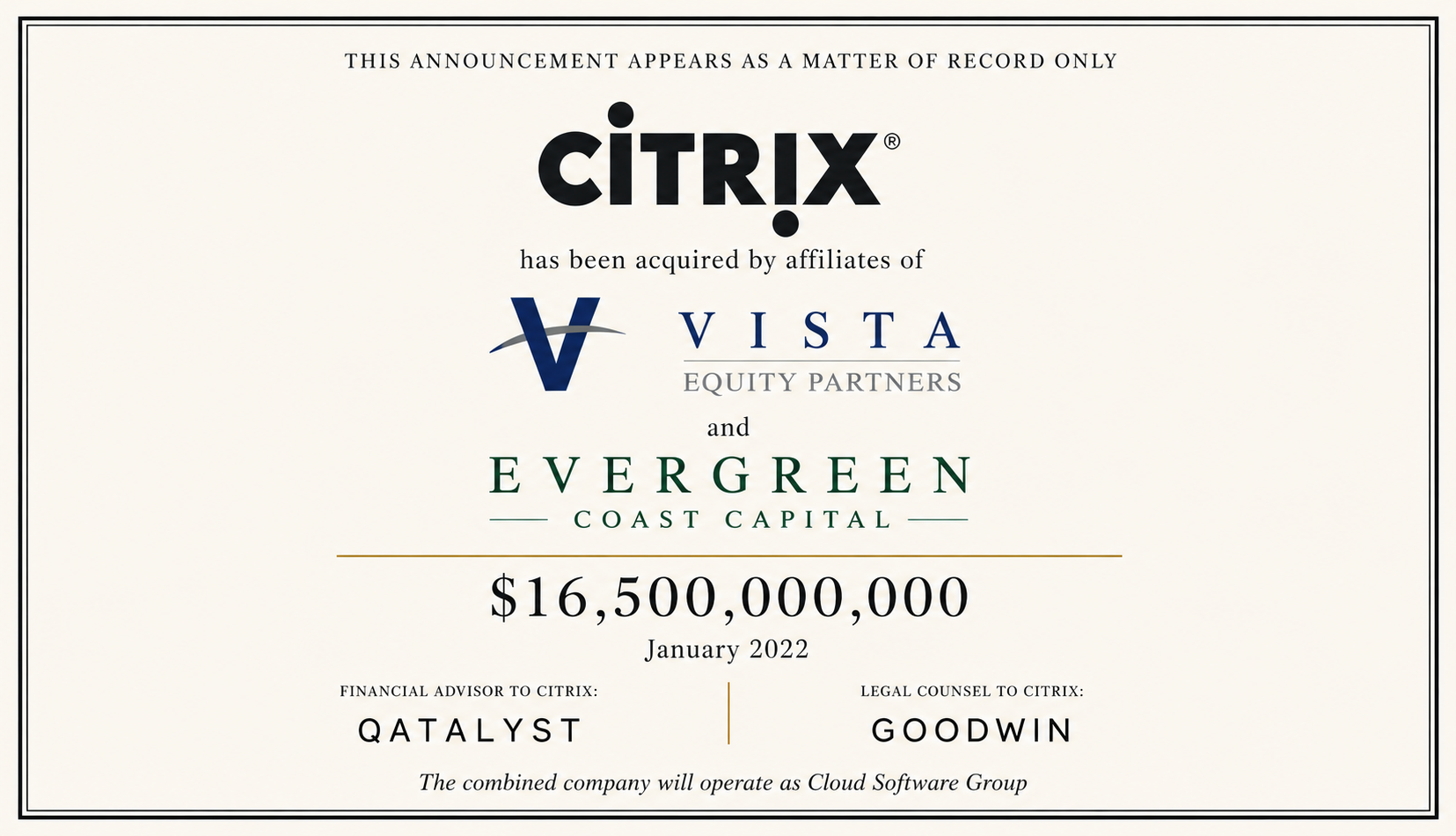
On January 31, 2022, Vista Equity Partners and Elliott Investment Management's private equity arm, Evergreen Coast Capital, agreed to take Citrix Systems private for $16.5 billion. The plan was to combine Citrix with TIBCO Software, an existing Vista portfolio company, into a new enterprise software platform. Banks committed roughly $15 billion of debt financing in the days before the announcement, priced to the credit conditions of January 2022.
Four weeks later, Russia invaded Ukraine. Within months, the Federal Reserve launched the fastest interest rate hiking cycle in four decades. The banks that had agreed to underwrite Citrix's buyout debt were suddenly holding a commitment priced for a market that no longer existed. By the time they finally sold the debt eight months later, in September 2022, they had lost more than $600 million combined.
This is the case study the LBO Mechanics article in this series was missing: a real leveraged buyout where the financing risk, the part of the model most candidates treat as a settled input, became the entire story. This article walks the deal end to end. The background, the rationale, the process, the valuation, the actual disclosed debt structure, the hung debt crisis in detail, the advisors and their fees, the integration, and how to use this case study in an interview.
Background: What Citrix Was at Announcement
Citrix was a legacy enterprise software company built around virtual desktop infrastructure, the technology that lets employees access a centralized corporate desktop from any device. In its fiscal year 2021, the company reported total net revenue of $3.22 billion, an overall 1% decrease compared to 2020. The headline number masked a business in transition: subscription revenue increased 39.4% to $1.55 billion and SaaS revenue increased 58.5% to $857.3 million, while product and license revenue decreased 61.5% to $171.2 million as Citrix wound down its legacy perpetual license model. Operating income decreased 61.1% to $236.6 million, a sharp profitability hit from the licensing wind-down and acquisition-related costs.
Elliott Investment Management was not a new presence at Citrix. Elliott first took a stake in Citrix in 2015 and held a board seat until 2020, pushing for strategic change as a public-market activist. The campaign didn't fully deliver the transformation Elliott wanted, and the stock underperformed software sector peers for years afterward. By late 2021, Elliott and its affiliates held approximately a 12% interest in Citrix through a combination of shares and derivatives, still the largest single holder with the deepest institutional knowledge of the company's problems.
The setup is worth naming directly: an activist that knows the company intimately, decides the public markets won't reward the turnaround it has in mind, and partners with a sponsor that specializes in exactly that kind of value creation play to take the company private and finish the job away from quarterly scrutiny.
The Strategic Rationale
Three threads justified the deal.
Vista's operating playbook. Vista Equity Partners is the most specialized enterprise software buyout firm in the market, with a documented, repeatable operating model for taking acquired software companies and driving margin expansion through pricing discipline, cost rationalization, and cross-sell. Vista had already run this playbook on TIBCO since acquiring it years earlier. Citrix was a natural extension: a mature, cash-generative software business with bloated costs and an underexploited subscription transition, exactly the profile Vista's model is built to improve.
The TIBCO combination. Combining Citrix with TIBCO was not a typical strategic bolt-on. The plan divided Citrix into three business units, Citrix itself for virtual desktops and digital workspaces, NetScaler, and ShareFile, while TIBCO contributed its core application and data integration group plus Jaspersoft and Information Builders. Two unrelated enterprise software product lines, virtual desktop infrastructure and data analytics, brought together under one holding company, betting primarily on cost synergies and a shared go-to-market motion rather than product synergy. It's worth being honest about this: the strategic logic for pairing these two specific companies was thinner than the financial logic. This was a cost and cross-sell play built on Vista's operational machine, not a product roadmap with obvious technical synergy.
Elliott's activist thesis, completed. Elliott's multi-year involvement signals this wasn't an opportunistic snap decision. The take-private was Elliott converting a public-market activist campaign that hadn't fully worked into direct ownership, where it could control the outcome rather than agitate from the sidelines.
The Process
The proxy materials reveal the deal had a leak. The $104.00 per share purchase price represented a 30% premium over the unaffected 5-day volume-weighted average price as of December 7, 2021, the last trading day before market speculation regarding a potential transaction, and a 24% premium over the closing price on December 20, 2021, the last trading day prior to media reports regarding a potential bid from Vista and Evergreen. Two separate reference prices, because the market had already started pricing in a deal before the official announcement. This is the same mechanic the M&A Premiums article in this series describes: leak inflates the "unaffected" price if you only look at the day before announcement, which is exactly why serious premium analysis reports multiple reference points rather than a single number.
The deal moved fast once it was live. Elliott and its affiliates entered into a voting agreement with Citrix, agreeing to vote their roughly 12% stake in favor of the transaction. With the largest shareholder locked in by voting agreement and no rival bidder emerging, the process had a clear inevitability once Vista and Elliott decided to move together. The board unanimously approved the transaction, and it closed without a financing condition, a detail that matters enormously to everything that follows.
The Valuation
Citrix shareholders received $104.00 in cash per share, an all-cash transaction valued at $16.5 billion including the assumption of Citrix debt. Clean structure, no contingent consideration, no stock component. The price represented a 30% premium to the unaffected 5-day VWAP and a 24% premium to the price just before deal speculation began.
On 2021 revenue of $3.22 billion, the $16.5 billion transaction value implies roughly 5.1x EV/Revenue, a multiple that reflects Citrix's mature, low-growth profile rather than any kind of growth premium. Worth contrasting briefly with Microsoft's acquisition of Activision Blizzard from earlier in this series, which priced at roughly 7.8x EV/Revenue. Two very different kinds of businesses: Activision was high-growth content IP with expanding subscription potential, while Citrix was a declining legacy enterprise software business being bought specifically because its operations were inefficient and fixable, not because its growth trajectory justified a premium multiple.
Sources and Uses: The Actual Leverage
This is the section that makes the LBO Mechanics article concrete with real disclosed numbers rather than illustrative ones.
The debt financing commitment letter, dated January 31, 2022, consisted of a senior secured term loan facility of $7.05 billion, a senior secured revolving credit facility of $1.0 billion, a senior secured bridge term facility of $4.0 billion, and an unsecured bridge term facility of $3.95 billion. Summing the funded tranches (excluding the revolver, which is conventionally undrawn at close and held in reserve for working capital): $7.05 billion plus $4.0 billion plus $3.95 billion equals exactly $15.0 billion of new debt, the figure referenced throughout subsequent reporting as "the $15 billion debt deal."
On the equity side, Elliott Associates and Elliott International committed, pursuant to an equity commitment letter dated January 31, 2022, to capitalize the deal vehicle with an aggregate equity contribution of $2.275 billion. That figure is Elliott's specific commitment; Vista's parallel equity commitment sits alongside it but wasn't disclosed at the same level of detail in the materials reviewed here. The total sponsor equity check, blending both firms' contributions, would sit meaningfully higher than Elliott's $2.275 billion alone.
Now the leverage question, where the numbers get genuinely interesting. Citrix did not publicly report an "EBITDA" line item, since EBITDA is a derived rather than GAAP-reported metric. Third-party calculation from Morningstar data puts Citrix's EBITDA for fiscal year 2021 at $529 million. Against that figure, $15 billion of new debt implies leverage above 28x, a number so far outside any real LBO underwriting range that it can't be what lenders actually priced.
Here's why the gap is so large, and it's a direct application of the EBITDA adjustment principle from the Comparable Companies article earlier in this series. The $529 million figure is close to a raw, largely unadjusted GAAP-based EBITDA. Citrix's 2021 cash flow statement shows stock-based compensation expense of $346.8 million alone, an addback any sponsor underwriting case would include. The company also recorded restructuring charges of $103 million in the fourth quarter of 2021 alone for severance and facility closures, a one-time item that would be stripped in any adjusted EBITDA calculation. Layer those two addbacks onto the $529 million base and you're already north of $950 million, before accounting for the run-rate cost synergies Vista's underwriting case would have baked in from combining Citrix's operations with TIBCO's and from the planned headcount reductions.
A defensible estimate of the "sponsor case" adjusted EBITDA that actually anchored the lending commitments sits somewhere in the $1.0 to $1.3 billion range, though the precise figure was never publicly disclosed and this is a derived estimate, not a reported one. At the midpoint of that range, $15 billion of new debt implies leverage of roughly 12 to 13x EBITDA. Still well above the 5 to 7x range the LBO Mechanics article describes as the typical entry leverage for a buyout, even accounting for software's premium credit treatment given high-margin, recurring revenue characteristics that historically supported more aggressive multiples than industrial or cyclical businesses.
The honest takeaway: this was an aggressively levered deal even by the frothy standards of late 2021, when leveraged loan issuance was running at record volumes and credit terms were unusually generous to borrowers. That aggressiveness is a meaningful part of why Citrix became the deal that broke when conditions turned, rather than one of the many large LBOs from that period that financed without incident.
The Hung Debt Crisis
The spine of this case study, and the part most prep material skips entirely.
Wall Street lenders including Bank of America, Credit Suisse Group, and Goldman Sachs Group committed to the roughly $15 billion debt package at the end of January 2022, in a deal not subject to a financing condition. That last detail matters enormously. A financing condition would have let the banks walk away if market conditions deteriorated before close. Without one, the banks were contractually obligated to fund the deal at the agreed terms regardless of what happened to the credit market in the intervening months.
A few weeks after the deal was announced, Russia invaded Ukraine, and the Federal Reserve embarked on its inflation fight in March. The Fed's hiking cycle that followed was the fastest in four decades. Leveraged loan and high-yield bond markets, the exact markets the Citrix financing depended on for syndication, effectively froze for new large-cap issuance for stretches of the year as investors demanded sharply higher yields to take on new risk.
The mechanical problem: banks had committed to provide Citrix's buyers with debt at January 2022 pricing. To get that debt off their own balance sheets and onto investors' books, the standard practice in leveraged finance, they needed institutional buyers willing to purchase the loans and bonds. But by mid-2022, the market would only clear that debt at yields far above what the banks had promised Citrix and Vista. The banks were stuck choosing between selling at a steep discount to par (eating the difference as a loss) or holding the debt on their own balance sheets indefinitely (tying up capital and capital ratios at exactly the moment regulators wanted banks to be conservative).
In September 2022, Wall Street banks completed the sale of $8.55 billion in loans and bonds backing the buyout, accepting a $700 million loss. Some of the secured bonds sold at just 83.6 cents on the dollar. The syndication was buoyed by Elliott itself, which helped by buying $1 billion of the bonds, an unusual move in which the deal's own sponsor stepped in to help its banks clear the syndication, partially absorbing risk that would otherwise have compounded the banks' losses or further depressed the clearing price for the remaining debt. Banks led by Bank of America were separately reported to be retaining roughly $2.5 to $3.5 billion of the loan on their own balance sheets rather than sell into the depressed market, a quieter form of the same loss, deferred rather than realized, sitting on the banks' books at a lower mark.
Citrix officially closed and merged with TIBCO at the end of September 2022, on the originally agreed economic terms for Citrix's former shareholders. They got their $104 per share regardless of what happened in the credit market between January and September. The losses landed entirely on the underwriting banks. Vista and Elliott's equity economics, locked in at signing, were untouched by the financing chaos playing out around them.
Why This Matters for LBO Mechanics
Direct callback to the framework laid out earlier in this series. The Citrix deal demonstrates three things about leverage in practice that no illustrative model can show as convincingly.
Financing risk is real, and it's asymmetric. A deal with no financing condition protects the seller (Citrix shareholders always knew they'd get paid) and the buyer (Vista and Elliott always knew they'd get the company), but it transfers the entire market risk in the gap between signing and close onto the underwriting banks. Most candidates think of LBO financing as a settled input you plug into a model. In practice, it's a live market exposure that can move by hundreds of basis points and hundreds of millions of dollars between the day a deal is announced and the day it closes.
The cost of leverage isn't fixed at announcement. The LBO Mechanics article describes interest rate sensitivity inside the cash sweep and debt schedule, the mechanical effect of a 200 basis point move on annual interest expense. Citrix is the real-world version of that sensitivity, scaled up to an entire syndication market. The same debt that needed to clear at a certain yield in January needed several hundred basis points of additional spread to clear by September, which is exactly the kind of shock that would blow apart a sponsor's IRR bridge if the sponsor, rather than the banks, had been the one holding the risk.
Sponsors and underwriting banks do not sit in the same risk position, even on the same deal. Vista and Elliott's economics were locked in at signing through their equity commitment letters. The underwriting banks' economics were exposed to eight months of market movement they had no control over. Understanding precisely who bears financing risk in a transaction, and over what window of time, is a distinction that separates analyst-level deal knowledge from associate-level judgment, and it's a distinction most prep guides never address because most illustrative LBO models assume the financing simply closes at the modeled rate.
The Advisors and the Fees
Qatalyst Partners served as financial advisor to Citrix, with Goodwin Procter LLP acting as legal counsel. Qatalyst is a tech-focused boutique, the same firm that has advised on a disproportionate share of major technology M&A over the past two decades, built on deep relationships with public technology company boards rather than balance sheet lending. For a take-private of a public technology company, Qatalyst's specific expertise in running a fair, defensible sale process for a tech board is exactly the credibility a target needs when the eventual buyer is a financial sponsor and an activist that already owns 12% of the stock.
Serving as financial advisors to Vista and Evergreen were BofA Securities, Barclays, Citi, Credit Suisse, Goldman Sachs, Lazard, and Mizuho Securities. Seven advisors on the buy side is a large roster, reflecting both the deal's size and the fact that several of these same institutions were also the underwriting banks providing the debt financing, wearing both an advisory hat and a lending hat simultaneously. Kirkland & Ellis LLP acted as legal counsel for Vista and TIBCO, while Gibson, Dunn & Crutcher LLP and Debevoise & Plimpton LLP acted as legal counsel for Evergreen. Three separate legal teams on the buy side alone, one for Vista's TIBCO entity and two for Elliott's Evergreen vehicle, reflecting how a club deal between two large, sophisticated sponsors requires careful, separately represented coordination even when both sides want the same outcome.
The fee economics here didn't work out as planned for everyone at the table. Advisory fees on a deal this size, even shared across multiple buy-side advisors, would typically run into the tens of millions of dollars and were presumably paid largely on signing or close, regardless of what happened afterward. The underwriting fees the banks earned for committing the $15 billion debt package are the more interesting case. Those fees are compensation for exactly the kind of risk that materialized: the risk that market conditions move between commitment and syndication and the bank can't pass the debt through at the committed terms. In a normal year, that fee is close to pure profit, since most leveraged loan commitments syndicate near par without drama. In 2022, the fee earned on the Citrix financing didn't come close to covering the eventual loss. This is the real, underappreciated explanation for why banks repriced their appetite for large leveraged loan commitments much more conservatively through 2023 and 2024, demanding tighter terms, more conditionality, and smaller individual commitments on subsequent mega-deals.
Integration and Outcome Through 2025
Vista and Evergreen tapped Tom Krause, formerly president of Broadcom Software and an architect of Broadcom's own pending acquisition of VMware, to lead the combined Cloud Software Group as CEO, announced in July 2022 ahead of the deal's close. The cross-reference is worth noting for readers of this series: Krause's prior role at Broadcom puts him directly inside the playbook discussed in the competitive landscape conversations elsewhere in HARDO's content, the aggressive cost-and-price discipline that has become Broadcom's signature approach to enterprise software M&A. Vista hired a practitioner of exactly that style.
In January 2023, shortly after the merger finalized, Cloud Software Group announced layoffs of approximately 15% of its workforce. The company eliminated about 2,250 jobs from a combined workforce of roughly 15,000, with cuts hitting commercial sales, marketing, channel-facing roles, and engineering. CEO Tom Krause framed the cuts as part of a focused 2023 product roadmap, concentrating direct sales and marketing on the company's 1,600 largest customers and eliminating investment in product areas outside that roadmap. The combination targeted roughly $400 million in annual cost synergies by some reporting, with other sources citing figures closer to $500 million, the kind of imprecision that's common when the underlying synergy target was never formally disclosed by the company itself. Additional targeted layoff tranches continued through 2024, shifting toward offshoring support roles to lower-cost regions and consolidating overlapping product lines.
By late 2024, Cloud Software Group reported annual revenue of roughly $4.3 billion and employed around 10,000 people globally, down meaningfully from the pre-merger combined headcount of Citrix and TIBCO together, consistent with the cost-reduction thesis having executed largely as planned. The company remains privately held under Vista and Elliott ownership, with no public disclosure of current leverage levels or performance against the original underwriting case, the same opacity that makes most large LBOs genuinely difficult to grade from the outside for years after close.
The honest verdict, two and a half years out: the equity holders, Vista and Elliott, got the company at their negotiated price regardless of how the financing crisis played out around them. The operating thesis, aggressive cost discipline and product line rationalization, appears to be executing closely to plan based on the revenue and headcount trajectory. The underwriting banks took a real, quantifiable financial hit that changed how the entire leveraged finance market priced large commitments for the following two years. Citrix and TIBCO employees absorbed the human cost of the restructuring. Whether the deal ultimately generates the IRR Vista and Elliott underwrote at signing depends on the eventual exit multiple and the EBITDA trajectory from here, neither of which is publicly observable yet.
How to Use This Case Study in an Interview
Which questions this answers. "Walk me through a recent deal" for any PE-track, leveraged finance, or sponsor-coverage interview. "Pitch me an LBO" or "walk me through how you'd think about levering this company" style prompts, where this deal gives you real disclosed tranche structure to reference rather than a generic textbook example. "Tell me about a deal where the financing didn't go as planned," a less common but real senior-track prompt, and this is close to the cleanest recent answer available. "How do you think about financing risk in a transaction" ties directly to this case and very few other candidates will have a concrete, sourced answer ready.
What to emphasize. The leverage was aggressive even for 2021 standards, roughly 12 to 13x on a reasonable estimate of adjusted EBITDA, well above the typical 5 to 7x range, and that aggressiveness is part of why this specific deal became the cautionary tale rather than one of the many large 2021-vintage LBOs that financed without incident. The financing timeline between signing and close is where the real risk sat, not in the equity economics, which were locked in from day one. Elliott's $1 billion bond purchase to help its own deal's banks clear the syndication is a specific, memorable, verifiable detail almost no other candidate will know, exactly the kind of differentiation this series of articles is built to provide.
What to skip in a 90-second version. The product strategy detail, the specific business unit breakdown of Citrix DaaS, NetScaler, and TIBCO Jaspersoft, unless the interviewer asks specifically about the combined company's product strategy. The granular layoff figures beyond the headline 15%, save the specifics for follow-ups.
The 60-second opening version:
"Vista Equity Partners and Elliott Investment Management took Citrix private for $16.5 billion in January 2022, combining it with Vista's existing TIBCO Software. The deal was financed with about $15 billion of new debt, committed at January 2022 pricing with no financing condition protecting the banks. Weeks later, the Fed started the fastest hiking cycle in forty years, and the leveraged loan market the banks needed to syndicate the debt into effectively froze. By September, the banks had to sell the debt at a steep discount, losing more than $600 million combined, with Elliott itself stepping in to buy a billion dollars of the bonds to help the syndication clear. Citrix's shareholders got their $104 a share regardless. The lesson is that financing risk in an LBO is real and it sits with whoever's holding the commitment between signing and close, which in this case was the banks, not the sponsors."
The follow-ups to be ready for. Why was leverage so high on this specific deal. What specifically broke in the financing market between January and September 2022. Why didn't Vista or Elliott bear any of the loss. Was this still a good deal for the sponsors despite the financing chaos. What would you have done differently if you were structuring the debt commitment.
Where to Drill
The Associate-level interviewer on HARDO pushes specifically on "walk me through a recent deal" and on LBO mechanics under sustained follow-up pressure. Citrix is the case study that proves the LBO Mechanics article's framework isn't theoretical. The financing risk it describes in the abstract actually happened, at real scale, with real, quantifiable losses, to some of the largest banks on Wall Street. Knowing this deal cold, including the parts that went wrong, is worth more in an interview than knowing five clean deals where nothing did.
Reading is reps. Now take the rep.
Drill this in a mock- Live Deal ExamplesThe $3.7 Billion Merger That Died a Month After Being Approved
Getty and Shutterstock's $3.7B merger died after the CMA approved it. The remedy math, the break mechanics, and the financing unwind, for IB interviews.
- Live Deal ExamplesThe $86 Billion IPO That Named Its Own Price
SpaceX's $86 billion IPO broke down for Investment Banking interviews: the fixed price, the greenshoe math, and the aftermarket that fell.
- Live Deal ExamplesHow Microsoft Closed a $68.7B Deal Three Regulators Tried to Stop
How Microsoft closed its $68.7B Activision Blizzard deal after three regulators tried to stop it. The financing, the divestiture, the lessons for IB interviews.