How Microsoft Closed a $68.7B Deal Three Regulators Tried to Stop
How Microsoft closed its $68.7B Activision Blizzard deal after three regulators tried to stop it. The financing, the divestiture, the lessons for IB interviews.
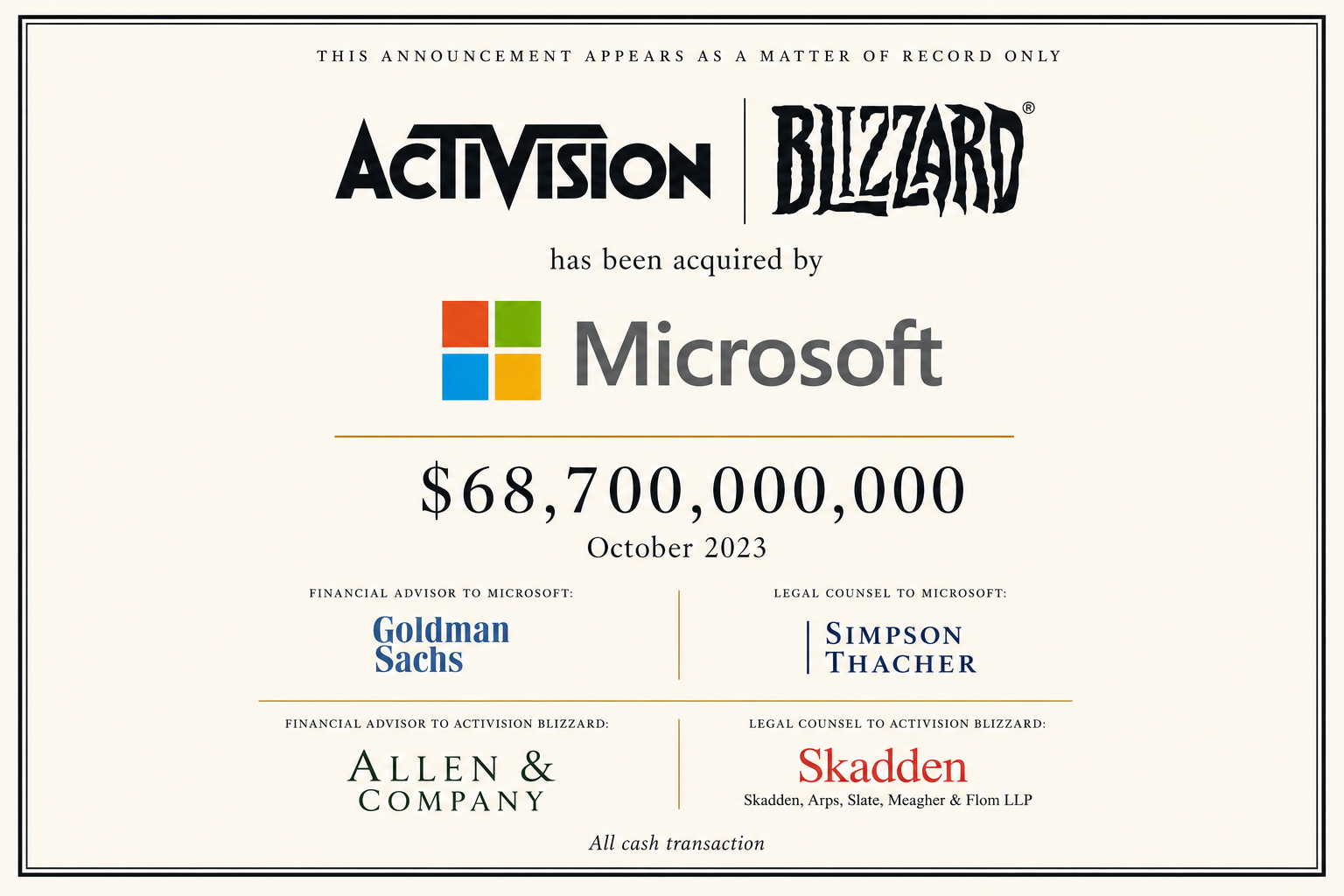
On October 13, 2023, twenty-one months after the announcement, Microsoft closed its acquisition of Activision Blizzard for $68.7 billion in cash. It was the largest gaming acquisition in history and, briefly, the largest all-cash technology deal ever recorded — surpassing Dell's $67 billion purchase of EMC in 2016. It was also the most contested antitrust process in recent M&A memory: three jurisdictions, three different outcomes, one divestiture that saved the deal.
The case study is unusually rich. Cash financing with a parallel debt issuance. A 45% control premium during a stock-pressured moment. A limited auction with no credible alternative bidder. A 21-month regulatory journey across the FTC, the European Commission, and the UK's CMA, each reaching different conclusions on different theories of harm. A restructured deal that divested cloud streaming rights to Ubisoft and broke the CMA's foreclosure theory. Two years of post-close integration to evaluate.
This article walks the deal end to end. The background, the strategic rationale, the limited process, the valuation and financing, the regulatory journey, the Ubisoft divestiture, integration through 2025. The final section is the one that matters most for HARDO's readers: how to actually use this case study in an interview when an MD asks you to tell them about a recent deal.
Background: What Each Company Was at Announcement
Activision Blizzard at announcement (January 2022). 2021 net revenues of $8.80 billion under GAAP, three studios (Activision, Blizzard, King), nearly 400 million monthly active users across the portfolio at peak, and a franchise list that included Call of Duty, World of Warcraft, Diablo, Overwatch, StarCraft, and Candy Crush. Call of Duty alone was generating roughly $3 billion in annual revenue. 2021 net income of $2.7 billion.
The stock had been hammered through 2021. The unaffected price on January 14, 2022 — the last trading day before the announcement — was $65.39, down roughly 30% from the February 2021 all-time high of $104. The reason was specific: in July 2021, California's Department of Fair Employment and Housing had sued Activision over allegations of workplace sexual harassment and a culture that the agency described as a "frat boy" environment. Bobby Kotick, CEO since 1991, was under intense employee and shareholder pressure. A Wall Street Journal investigation in November 2021 raised further questions about what Kotick had known and when. The stock was vulnerable in a way it hadn't been in years, which is part of why this deal happened when it did.
Microsoft at announcement. More than $130 billion in cash at the end of 2021, market cap above $2 trillion, FY2022 revenue trajectory north of $200 billion. Azure cloud was the strategic center of the company under Satya Nadella, Office 365 was a stable cash machine, and gaming sat as a strategic but not central division: Xbox in third place behind Sony's PlayStation and Nintendo's Switch, Game Pass growing fast as a subscription product.
It's worth flagging the timing context. The deal was announced in January 2022. ChatGPT launched in November 2022, ten months later. The AI narrative that has since dominated Microsoft's story did not exist at announcement. Nadella's framing leaned heavily on the metaverse, which has aged questionably. The honest read: the strategic logic was sound on gaming alone; the metaverse framing was real but secondary, and has since faded as the AI story took over.
The Strategic Rationale
Five threads justified the price.
Content for Game Pass. Microsoft's subscription service needed marquee IP to differentiate from PlayStation Plus and to anchor the long-term thesis that gaming was moving from disc sales to subscriptions. Activision's portfolio — and specifically Call of Duty — would be the anchor. The strategic value of CoD on Game Pass was the largest single economic argument for the deal, both for consumer acquisition and for retention.
Mobile gaming at scale. Microsoft was structurally weak in mobile. King, Activision's casual mobile arm, brought billions of monthly sessions and an established presence in a segment Microsoft couldn't reach organically. Candy Crush alone has a multi-billion-dollar annual run-rate. Mobile is where the gaming market grew most in the 2010s, and Microsoft owned almost none of it.
Cloud gaming. Activision titles would anchor xCloud, Microsoft's cloud gaming service. This was the rationale the CMA later blocked the deal on (covered below). Strategically it was real; legally it became the problem.
IP control and bargaining power. Owning franchises directly removes the third-party negotiation. Microsoft no longer had to negotiate with Activision on Call of Duty for Game Pass; it could decide unilaterally. Vertical integration in gaming is a tool for controlling distribution.
The metaverse. Nadella explicitly framed the deal as building blocks for the metaverse in the announcement. The framing has aged. Microsoft's own metaverse initiatives (HoloLens, Mesh) have not been central to subsequent strategy. In hindsight this looks like the framing of the moment rather than a durable thesis.
A contrarian read worth surfacing: was Microsoft buying growth or buying defense? Sony had been steadily widening the PlayStation lead. PlayStation Plus was iterating on subscription mechanics. Tencent and other Chinese publishers were extending global reach. The defensive reading — Microsoft locking up Activision before Sony or anyone else could — is at least as plausible as the offensive reading. Whichever frame you use, the strategic logic was specific and defensible.
The Auction That Wasn't
Per the proxy statement, Microsoft approached Activision in late 2021 directly. The board's process was limited: no formal auction, no market check before the announcement, no banker shop of the asset to other strategics. The 30-day go-shop period after announcement produced no superior proposal.
Why no other bidder emerged is itself the answer. The universe of buyers for a $68 billion gaming asset is small. Sony was the obvious competitive bidder, but a Sony / Activision tie-up would have faced its own antitrust scrutiny (Sony would have controlled both the largest console platform and Call of Duty), and Sony lacked the balance sheet. Tencent could write the check but faced US national security review on any acquisition of that scale. Apple, Amazon, and Meta had reasons not to bid: Apple was hostile to Microsoft strategically, Amazon was unprofitable in gaming generally, Meta was distracted with the metaverse. Take-Two and EA were too small. The set of credible alternative bidders was effectively empty.
This shaped the price discussion. Microsoft knew it was the only credible bidder. Activision knew Microsoft knew. The 45% premium reflects two things: the strategic value Microsoft assigned to the IP, and the leverage Microsoft had to walk away if the price ran too far. The premium was high relative to typical M&A (20–35%), but not high relative to the strategic uniqueness of the asset.
Bobby Kotick stayed in role through close, which is itself a piece of the negotiation history. His support of the deal was a critical asset to Microsoft — he held the board, he held the shareholder vote — and he stayed despite calls for his removal because the deal needed him to. He exited at close.
The Valuation
$95 per share in cash, all-cash, no contingent value rights, no stock component. A 45 percent premium to Activision's closing price on January 14, 2022 of $65.39. The structure was as clean as M&A gets.
The multiples at announcement, using 2021 financials:
Equity value:         $75.0B (gross)
Less net cash:        $6.4B
Enterprise value:     $68.7B

2021 revenue:         $8.8B  → 7.8x EV/Revenue
2021 EBITDA (~):      $3.8B  → 18.1x EV/EBITDA
2021 net income:      $2.7B  → 27.8x P/E
The 18x EV/EBITDA multiple sat within the gaming sector trading range at announcement. Take-Two, EA, and other public gaming pure-plays were trading at 15–18x forward EBITDA. Microsoft was paying the high end of the trading range plus a control premium: the all-in premium-adjusted multiple was at a clear premium to the sector but not out of bounds.
Premium comparison to recent gaming precedents helps calibrate. Take-Two's acquisition of Zynga, announced two weeks before this deal at $12.7 billion, was at a roughly 64% premium. Activision's own 2016 acquisition of King was a roughly 20% premium. Microsoft's 45% premium sat in the middle of the range: high enough to clear the board hurdle on Activision's side, low enough that Microsoft wasn't being obviously fleeced.
What the price reflected: not just the standalone value of Activision, but the strategic value of the IP to Microsoft specifically. Call of Duty on Game Pass is worth more to Microsoft than to any other potential buyer. King's mobile platform is worth more to Microsoft than to any other strategic acquirer. The premium captures the unique fit, not just the sector multiple.
The Financing
Microsoft was able to fully fund the deal without taking additional debt due to its strong cash position, with more than $130 billion in cash at the end of 2021. No equity issued. No new debt required for the purchase price itself, though Microsoft did issue some bonds in 2023 for general corporate purposes. The financing was as simple as a $68.7 billion deal gets: wire the cash, close.
The accretion math under the article #5 framework:
Foregone interest on $68.7B of cash at ~4%:  $2.7B pre-tax
After-tax (21% federal rate):                ~$2.1B
Activision 2021 net income:                  +$2.7B
Net annual impact before synergies:          +$0.6B

Plus expected cost and revenue synergies from Game Pass uplift,
mobile platform integration, and cost overlap reduction.
At announcement, the deal was projected to add about $0.26 in EPS against Microsoft's then-$8.05 baseline, roughly 3% accretive. Small in percentage terms, but Microsoft's net income base of roughly $73 billion in FY2023 means the absolute dollar addition is substantial. The deal was never about EPS accretion. It was about strategic IP control. The accretion math was just confirmation that the deal didn't destroy value on the way to delivering the strategy.
This is the standard frame for cash deals by cash-rich acquirers. When the after-tax foregone interest on cash is 3% and you're acquiring earnings at a 6–7% yield, the spread carries the math. The acquirer doesn't need synergies to make the deal accretive. It needs them to make the deal strategically justify the premium, which is the harder question.
The Advisor Lineup and the Fees
The advisor lineup on a deal this size is itself worth studying because it tells you something about how senior IB relationships actually work.
Microsoft's side. Goldman Sachs & Co. LLC as exclusive financial advisor. Simpson Thacher & Bartlett LLP as legal counsel, with Alan Klein leading the M&A team. Weil, Gotshal & Manges LLP advised on international and EU competition matters, with Michael Moiseyev and the Brussels team handling the EU process.
Activision's side. Allen & Company LLC as exclusive financial advisor, with Skadden, Arps, Slate, Meagher & Flom LLP as US legal counsel (Kenton King leading the M&A team). Slaughter and May handled UK competition matters, with Claire Jeffs running the CMA engagement.
The interesting piece is on the Activision side. Allen & Company is not a name most candidates have on their target list. It's a privately-held boutique with roughly 175 employees, no public M&A league table participation, and a brand built almost entirely on senior relationship banking, particularly in media, technology, and entertainment. They host the annual Sun Valley conference. They've advised on the bulk of major media M&A over the last forty years (Disney/ABC, Disney/Pixar, Disney/Lucasfilm, the Time Warner deals) and they had a long relationship with Activision specifically: they advised on the Vivendi spin-off in 2013 and the King acquisition in 2016. Bobby Kotick knew the senior partners personally. That relationship was the mandate.
Why does this matter for the deal? Two reasons. First, conflicts. Goldman had a deep banking relationship with Microsoft (LinkedIn, GitHub, ZeniMax; Goldman has advised on most major Microsoft M&A). If Activision had also hired Goldman, the conflict check would have been impossible. The boutique fills the gap by structurally not having conflicts on a deal this size. Second, senior attention. At a bulge bracket, a $68B deal gets the senior banker for the pitch and the analyst-and-associate team for execution. At a boutique like Allen & Co, the senior partners stay on the deal end-to-end. For a target board navigating reputational risk (Kotick controversies, employee unrest, an in-flight DFEH lawsuit), that kind of senior continuity matters more than league table optics.
The fee economics. Activision Blizzard agreed to pay Allen & Company an aggregate cash fee of $65 million, of which $10 million was payable upon delivery of Allen & Company's opinion and $55 million was payable contingent upon consummation of the merger. The structure is standard IB fee architecture: a small retainer-and-opinion fee paid regardless of outcome (the $10M for the fairness opinion, delivered January 17, 2022, the day before the announcement), and a much larger success fee contingent on close.
On a $68.7 billion deal, $65 million is roughly 9 basis points (0.09%). That ratio surprises candidates the first time they see it. M&A fees on small deals run 1–2% of deal value. On mid-market deals ($500M–$2B), fees compress to roughly 0.5–1%. On mega-deals, fees compress dramatically: by the time you're at $50B+, the percentage falls below 0.15%, sometimes well below. The absolute dollars are still large, but the spread is structural: there isn't 100x more work on a $68B deal than a $680M deal, so the fee scales sub-linearly with deal size.
Goldman's fee on the Microsoft side wasn't disclosed in the proxy, since the acquirer isn't required to file a proxy statement when the consideration is cash (no acquirer shareholder vote). Market practice suggests Goldman's fee was in a similar range: likely $30–70 million for a mega-deal of this scale, structured similarly with a small announcement fee and a larger close fee.
The regulatory phase changed the legal economics. Twenty-one months of antitrust work across the FTC, the European Commission, the CMA, plus another dozen jurisdictions, generated enormous billable hours. Simpson Thacher and Weil Gotshal billed Microsoft for the FTC trial in San Francisco, the EU Commission engagement in Brussels, and the CMA process in London: three parallel litigation tracks running in three different procedural systems. Skadden and Slaughter and May ran the corresponding work on the Activision side. Aggregate legal fees over the deal's life almost certainly ran into nine figures across both sides combined, though specific numbers were never publicly disclosed.
For an IB candidate, the interview-relevant takeaway is that mega-deal fee economics are different from what most candidates assume. Boutiques can absolutely win mandates of this size on relationship and conflict grounds, basis-point fees on mega-deals are low but absolute dollars are real, the regulatory phase generates outsized legal billables on contested deals, and fairness opinions are themselves a distinct revenue line ($10M for one document, paid regardless of outcome). When an interviewer asks "why did Activision hire Allen & Company over a bulge bracket," the answer is not "because they're better." The answer is conflict, relationship, and senior continuity, the three things that actually drive advisor selection on contested deals.
The Regulatory Journey
The meat of the case study. Three jurisdictions, three theories of harm, three outcomes — and a divestiture that broke the most binding theory and let the deal close.
FTC (United States). Sued in December 2022 to block the deal on competition grounds, with the theory of harm focused on console competition: Microsoft would withhold Call of Duty from PlayStation, or degrade it, foreclosing Sony's competitive position. Microsoft countered by offering a 10-year public commitment to keep Call of Duty on PlayStation and by entering parallel licensing agreements with Nintendo, Nvidia GeForce Now, Boosteroid, Ubitus, and Nware to extend Activision games to those platforms. In July 2023, the FTC's preliminary injunction was dismissed by the Northern District of California on the merits. Judge Jacqueline Scott Corley ruled the FTC had not established likelihood of success. The FTC appealed to the Ninth Circuit but did not get the injunction reinstated. The deal closed. Two years later, in May 2025 the Ninth Circuit affirmed the district court's decision in favor of Microsoft.
European Commission. Approved conditionally in May 2023 with a remedy package centered on cloud gaming licensing. Microsoft committed to grant a free 10-year license to consumers in the EEA, allowing them to stream all current and future Activision PC and console games via any cloud gaming service of their choice, plus a parallel free license to cloud gaming service providers. The Commission's view was that Microsoft's commitments were fundamentally pro-competitive and would unlock significant benefits for competition and consumers. The Commission cleared the deal and moved on.
CMA (United Kingdom). Where it got interesting. The CMA blocked the deal in April 2023 — and crucially, not on the FTC's console theory. The CMA blocked on cloud gaming. Its theory: Microsoft, by owning Activision content and by operating Azure, would foreclose competitors in the nascent cloud gaming market. The CMA rejected Microsoft's behavioral commitments as insufficient. The CMA's view was that the remedies initially offered by Microsoft were insufficient to address its concerns, and its assessment of the cloud gaming market diverged sharply from the European Commission's.
This is the most interview-relevant piece of the regulatory story: two sophisticated regulators looking at the same deal reached opposite conclusions on the same theory of harm. The EC accepted licensing commitments. The CMA didn't. Microsoft had to pick a path.
The path was a divestiture.
The Divestiture
In August 2023, Microsoft restructured the deal, transferring cloud streaming rights for all current and new Activision Blizzard PC and console games released over the next 15 years to Ubisoft Entertainment SA. The transfer of rights for current games is perpetual; new games are covered for the 15-year window. The divestiture is outside the European Economic Area only; the EU had its own remedy via licensing.
Mechanics in detail:
- Ubisoft acquires the right to distribute Activision games through cloud streaming services outside the EEA
- Ubisoft can offer the games via Ubisoft+ Multi Access, its own subscription, or license them to other cloud services (Nvidia GeForce Now, Boosteroid, others)
- Ubisoft cannot grant Microsoft an exclusive license to Activision's games, and Microsoft cannot charge Ubisoft a wholesale price higher than the PC or console price (whichever is lower)
- Ubisoft can require Microsoft to adapt Activision titles to non-Windows operating systems if requested
The CMA didn't approve immediately. In September 2023, the CMA's Phase 1 decision on the restructured deal still found residual concerns about whether the Ubisoft agreement could be circumvented, terminated, or not enforced. Microsoft and Activision offered undertakings in lieu of a Phase 2 reference: additional commitments aimed at ensuring the divestiture would be fully implemented. The CMA accepted the undertakings on October 13, 2023, and on the same day provided consent under the original prohibition order. The deal closed that same day.
The lesson for any reader who'll be working on M&A: when a regulator blocks on a specific theory of harm, the path to closing isn't to argue harder. Microsoft argued for fifteen months and didn't move the CMA. The path is to divest the asset that creates the regulator's concern. Microsoft sold the cloud streaming rights — the asset at the center of the CMA's theory — to a neutral third party. The theory collapsed. The deal closed six weeks later.
The economic cost of the divestiture: real but limited. Cloud gaming was a small fraction of the value Microsoft was buying. The vast majority of Activision's revenue is console and PC sales, full-priced game launches, in-game purchases, and subscriptions, none of which the divestiture touches outside Europe. Microsoft gave up the cloud streaming rights and kept the value.
Integration and Outcome Through 2025
Activision Blizzard now sits within Microsoft Gaming under Phil Spencer. Bobby Kotick exited at close, as the agreement contemplated.
Major actions since close:
January 2024 layoffs across Microsoft Gaming, approximately 1,900 positions, including Activision Blizzard and Xbox teams: the largest single round of cuts in the division's history and a clear signal of cost discipline post-close. Diablo IV added to Game Pass in March 2024, the first major Activision title to launch on the subscription. Call of Duty: Modern Warfare III added to Game Pass later in 2024, the first time a new Call of Duty release launched directly on the subscription, validating the core thesis of the deal. Continued release schedule for Activision franchises through 2024 and 2025, with the Call of Duty franchise continuing on PlayStation per the 10-year commitment.
Microsoft Gaming revenue surged in the quarters following close, with much of the lift attributable to Activision contribution. The financial integration has been smooth, predictable for an all-cash deal where the acquirer was substantially larger than the target. The strategic integration has been more interesting: Game Pass momentum has accelerated with the Activision content, mobile presence has grown via King, and Microsoft's bargaining position with publishers has strengthened.
The verdict at the two-year mark: financially absorbed without strain, strategically delivering on the core Game Pass content thesis, integration messy but on track. The 10-year strategic logic of the deal is too early to fully judge. The 18-month operational outcome is positive.
What didn't happen: the AI narrative didn't change the gaming integration. Microsoft has continued to invest in Activision IP through the gaming arm while AI investment runs through Azure and the OpenAI partnership. The metaverse framing from the original announcement has faded entirely. The deal's strategic justification today sits on Game Pass and mobile, not the metaverse.
How to Use This Case Study in an Interview
This is the part that matters for HARDO readers. The whole point of the deep dive is to convert the knowledge into interview leverage.
#### Which Interview Questions This Case Answers
- "Walk me through a recent deal." Top-three pick for any TMT or generalist coverage interview, and increasingly for sponsors interviews as well.
- "Pitch me a deal." If you're pitching gaming consolidation, Microsoft / Activision is the precedent. If you're pitching anything where regulatory risk is material, this is the case study.
- "What deal has been interesting to you and why?" The CMA restructure is the angle most candidates miss. Talking about the regulatory journey rather than the deal terms is the differentiation.
- "How do you think about regulatory risk in M&A?" The canonical recent example. Three regulators, three outcomes, one divestiture.
- Sector-specific questions in TMT, media, or gaming coverage: knowing this deal is table stakes.
#### What to Emphasize in a Strong Answer
The regulatory restructure, specifically the CMA divestiture. Most candidates will talk about the FTC fight because the FTC story was the most public. The CMA story is more interesting and more interview-relevant: it's the story where a behavioral remedy failed and a structural divestiture succeeded. That's the lesson with the longest legs in M&A practice.
The clean accretion math given Microsoft's cash position. The framework from article #5 — foregone interest as the cost of cash deals — applies here in a textbook way.
The strategic logic in three threads: Game Pass content, mobile expansion, IP control. Don't lean on the metaverse framing; it's aged poorly.
The premium analysis. 45% is high for typical M&A and reflects the strategic uniqueness of the asset plus the limited bidder universe.
#### What to Skip in a 90-Second Walkthrough
Detailed integration commentary. Save for follow-ups if the interviewer pushes.
Bobby Kotick controversies. Tangentially relevant, but a side conversation that doesn't add to your demonstration of deal mechanics. Mention if asked specifically.
Counterfactuals ("what if AI had been the bigger story when this was announced") are interesting but not interview-relevant. Stay grounded in what the deal actually was.
#### The 60-Second Opening Version
Sample script for "tell me about a recent deal":
"Microsoft's acquisition of Activision Blizzard closed in October 2023 for $68.7 billion in cash. Microsoft paid $95 per share, a 45% premium to Activision's unaffected price, financed entirely from its $130 billion cash balance with no equity issuance. The strategic logic was Game Pass content — particularly Call of Duty — plus mobile expansion via King. The deal was nearly killed by the UK's CMA on cloud gaming foreclosure concerns, but Microsoft saved it by divesting Activision's cloud streaming rights outside the EEA to Ubisoft for 15 years. Clean strategic rationale, aggressive premium reflecting the IP value and the limited bidder universe, and a textbook example of structural divestiture saving a deal that behavioral commitments couldn't."
About 65 seconds spoken. Hits price, structure, financing, rationale, regulatory journey, and the lesson, without losing the interviewer to detail.
#### The Follow-Ups to Be Ready For
- "Why did Microsoft pay 45%?" Strategic value of IP for Game Pass and mobile. Limited number of comparable assets in the market. Sole credible bidder dynamic.
- "Was the deal accretive?" Yes, modestly. Activision's net income exceeds the after-tax foregone interest on the cash, before synergies. The deal added roughly 3% to EPS.
- "Why did the CMA block it?" Cloud gaming foreclosure theory. The CMA viewed Microsoft's behavioral commitments — licensing agreements with competitors — as insufficient, particularly given Microsoft's ability to circumvent or under-enforce them over time.
- "How did Microsoft save the deal?" Structural divestiture. Ubisoft acquired the cloud streaming rights outside the EEA, removing Microsoft's ability to foreclose cloud gaming competitors. The CMA's theory of harm collapsed.
- "Was this a good deal?" Too early to definitively judge. Strategically delivering on Game Pass content. Integration has gone reasonably well. The metaverse framing has aged poorly but wasn't the core thesis.
The candidates who handle this case study well in interviews aren't the ones who memorize the deal terms. They're the ones who can talk about why the CMA restructure matters, what it teaches about regulatory remedies, and how Microsoft's cash position made the financing arithmetic uninteresting in a useful way. The mechanics are the surface. The judgment is the differentiation.
Where to Drill
The Analyst- and Associate-level interviewers on HARDO are built for exactly this conversation. "Tell me about a recent deal" is a 90-second walkthrough that opens into 5–10 minutes of follow-ups, and the follow-ups are what decide the interview. Pick a deal, learn it cold, then run it against pushback until the answers are reflexive.
Microsoft / Activision is the canonical pick. Volume 2 in this series will pick a different one — different sector, different structure, different lesson.
Reading is reps. Now take the rep.
Drill this in a mock- Live Deal ExamplesThe $3.7 Billion Merger That Died a Month After Being Approved
Getty and Shutterstock's $3.7B merger died after the CMA approved it. The remedy math, the break mechanics, and the financing unwind, for IB interviews.
- Live Deal ExamplesThe $86 Billion IPO That Named Its Own Price
SpaceX's $86 billion IPO broke down for Investment Banking interviews: the fixed price, the greenshoe math, and the aftermarket that fell.
- Live Deal ExamplesThe $16.5B Buyout That Left Wall Street Holding $600 Million in Losses
The $16.5B Citrix buyout, the leverage, the hung debt crisis that cost banks $600M, and the lessons for investment banking interview LBO questions.