The Month in Question: July 2026
The Month in Question, July 2026: the Fed's 9-3 split, the Getty-Shutterstock collapse, Sky's ITV deal, SpaceX in the index, and how to defend each view.
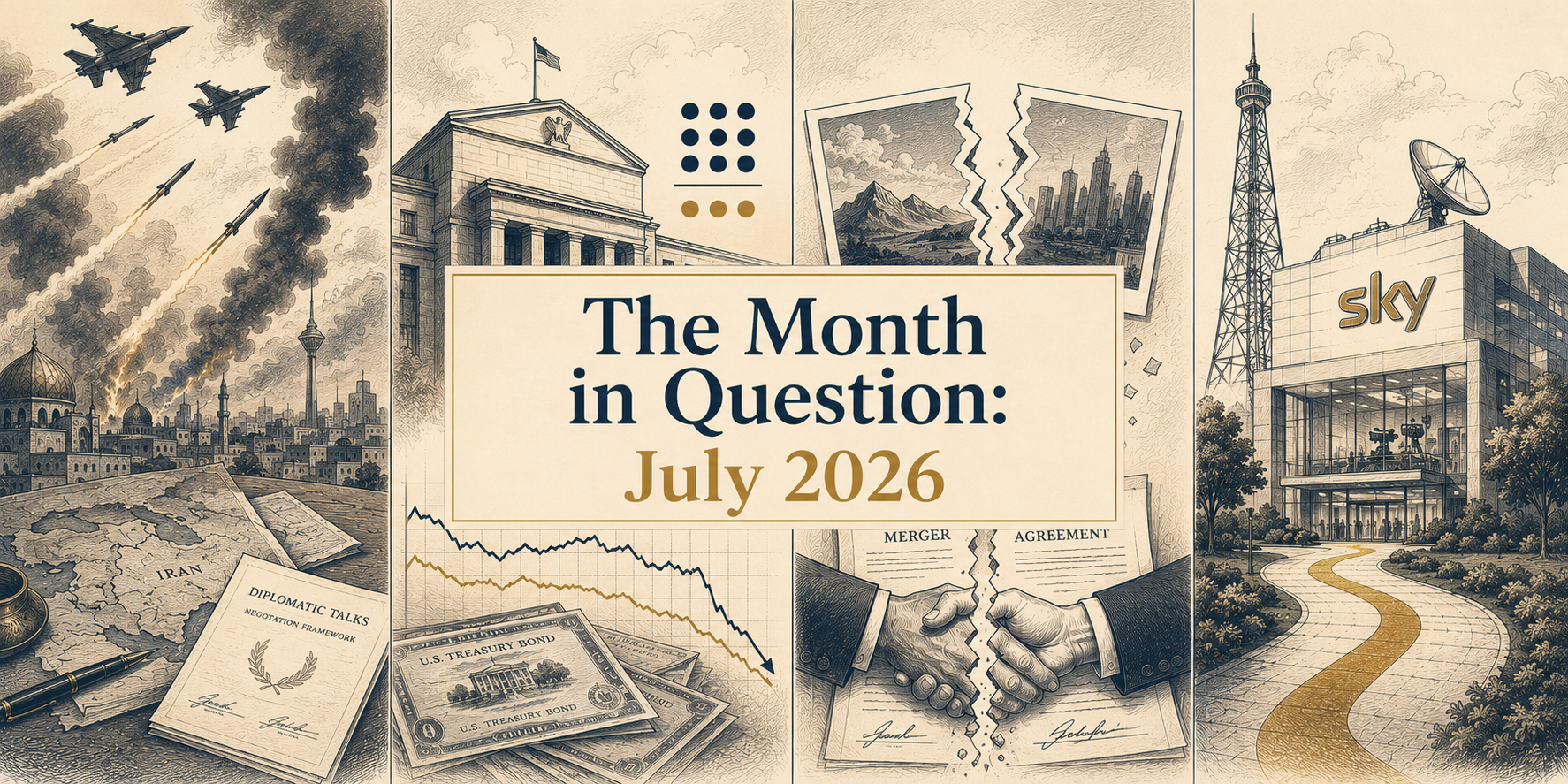
"What's going on in markets" is not a request for headlines. It's a request for a view you can defend, and the follow-up will take the other side of whatever you say. This is the second edition of the monthly series built for exactly that, now organized the way interviewers actually source their questions: geopolitics, macro, and the deal tape. Each event comes with what happened, why a banker cares, the defensible views, and the version you can say out loud.
July was a month of splits. Central banks divided internally on two continents, a war escalated inside its own negotiation window, and in the same week one UK deal died on a regulator's condition while another walked voluntarily into a review by the same regulator.
Geopolitics
The Iran War: Escalation Inside the Negotiation
What happened. The 60-day negotiation window opened by the US–Iran Memorandum of Understanding signed in June kept running. The fighting didn't. Through July, US forces said they struck more than 300 Iranian targets, Iran rejected an Omani proposal to share control of the Strait of Hormuz, and reporting indicated Chinese shoulder-launched missile systems would reach Iran within weeks. Iranian attacks hit three commercial tankers, giving the war what one analysis called a Houthi problem, and then the whiplash: Iran signaled it would stop carrying out attacks as long as the United States also refrains, after Washington suspended its bombing campaign, only for Trump to threaten to hit Iran hard in the final days of the month, with oil prices rising on the threat.
Why a banker cares. Last month's edition flagged this story as priced rather than settled. July is what priced-not-settled looks like in practice. The market has stopped repricing the shock and started repricing the probability distribution, which is why oil chops instead of trending: every de-escalation headline fades the premium, every escalation headline rebuilds part of it. Two structural facts cap the upside. China, the single biggest buyer, keeps finding ways to get Mideast oil regardless of the conflict, and positioning already unwound the war premium months ago, so fresh escalation hits a market with little hedge left rather than one waiting to panic.
The pushback. "So does the war matter for markets or not?" The June answer still holds: it matters when it produces sustained economic disruption and gets faded when it doesn't. The July addition is the falsifier. Name what would make you re-add a risk premium, and it's sustained Strait disruption with tanker flows actually falling, not rhetoric, not strike counts.
Thirty-second version: "The ceasefire framework survived July but barely. Three hundred US strikes, tanker attacks, a rejected Hormuz proposal, then a pause-for-pause, then fresh threats into month-end. Oil chopped rather than trended because the market is pricing probabilities now, not the shock. I'd re-add a real premium only on sustained flow disruption through the Strait, and I'd note China is still buying either way."
The Tariff Front Reopened
Two developments worth carrying into any cross-border conversation. The US announced 50 percent tariffs on $20 billion of Canadian imports, accusing Ottawa of discriminating against American automotive interests, a reminder that trade weapons now get pointed at allies, not just rivals. Meanwhile the EU moved toward stronger competitiveness and trade-defense measures as tensions with China rose, and the semiconductor supply chain continued displacing the tariff schedule as the most consequential instrument of strategic coercion. The banker translation is unglamorous but real: cross-border deal models now carry a tariff scenario as a standard case, supply-chain capex keeps reshoring selectively, and any client with US–Canada automotive exposure just had its quarter rewritten.
Ukraine's Naval Turn
One paragraph, because the market impact is sectoral rather than systemic this month. The Russia–Ukraine war took a noticeably naval turn, with attacks intensifying at sea. Watch shipping, marine insurance, and grain logistics rather than broad indices. If asked, that sector-versus-systemic distinction is itself the answer.
Macroeconomic
The 9–3 Hold, and the Bond Market's Answer
What happened. On July 29, the FOMC held the federal funds rate at 3.50–3.75 percent by a 9–3 vote, and the three dissents wanted the opposite of what dissents usually want: Kashkari, Logan, and Hammack voted for an immediate 25 basis point hike, the most dissenting votes on the committee in years. Warsh gave the market nothing to hold onto. Asked about the decision not to hike, he said "I wouldn't characterize what we did as anything like a pause," and summed up his approach as "market participants are learning to play the ball, not the referee."
The market's answer was the real event. The Dow fell more than 840 points intraday, and the 30-year Treasury yield jumped more than 9 basis points to 5.193 percent, in one of the largest long-bond selloffs at an FOMC meeting in over a decade, with the curve bear-steepening as markets challenged inflation credibility and worried the Fed might act through the balance sheet instead of the funds rate. The complication that makes this rich: CPI actually cooled to 3.5 percent mid-month, equaling its lowest readings since 2020, yet consensus settled on a September hike, with markets having priced a meaningful chance of a July move going in.
Why a banker cares. The funds rate didn't move, and it didn't need to. The long end is the discount-rate anchor for every DCF and the gravity on every exit multiple, so a 30-year through 5.19 percent moves terminal values across the building even in a month when the Fed did nothing. Sponsor pipelines stay on the 2027 math this series has tracked since June. And the mechanism is worth naming precisely: the long bond sold off into cooling inflation because the market read ambiguity plus dissent as a credibility question, and credibility questions get charged at the long end, not the front.
The two views. View A: Warsh's refusal of forward guidance is deliberate discipline, forcing markets to price data rather than speeches, and the discomfort is the point. View B: ambiguity from a new chair with a split committee is not strategy, it's noise, and the 30-year selloff is the market invoicing the Fed for it in real time. June scoreboard: last month's View B, that the hike tilt had room to run, is winning, but through the long end rather than the dot plot.
The pushback. "If inflation is cooling, why did the long bond sell off?" The defensible answer separates the front of the curve, which prices the path of the funds rate, from the back, which prices decades of inflation credibility. July's print helped the front. The press conference hurt the back.
Thirty-second version: "The July FOMC held at 3.50 to 3.75 with three dissents for a hike, the most in years, and Warsh gave no guidance at all. The tell was the long end: the 30-year jumped through 5.19 in one of the biggest FOMC-day selloffs in a decade even though CPI had just cooled to 3.5. The market charged the credibility question to the back of the curve. For deals, the funds rate is a headline and the long bond is the discount rate, and the discount rate went the wrong way."
The BOJ, One Day Later
The Bank of Japan held its policy rate at 1.0 percent, its highest level since September 1995, by an 8–1 vote, with board member Hajime Takata dissenting in favor of a hike to 1.25 percent. The hold followed a 25 basis point hike in June, and the board warned that underlying inflation could exceed the 2 percent target even as it cut its FY2026 inflation forecast to 2.5 percent, citing government measures to ease household energy costs.
Read it next to the Fed and the pattern is the story: the world's two most-watched central banks both held in the same week, both over hawkish dissent. The global bias has tilted toward tightening for the first time in years, and the yen-carry thread from June's edition stays live, because a BOJ at generational-high rates keeps pressuring the funding trade that has quietly financed global risk assets for a decade. For cross-border M&A, the rate-differential math that shaped the first half hasn't resolved. It's compressed slightly, from both ends.
Earnings as the Counterweight
The month's growth evidence, in one paragraph. The day after the Fed selloff, the Nasdaq finished 2.8 percent higher, snapping a six-day losing streak, with Microsoft and semiconductors driving the gains as investors digested Microsoft and Meta earnings with Treasury yields at long-term highs. That is the tape's current equation stated plainly: the earnings picture is doing the work the rate picture won't. If mega-cap results had cracked in the same week as the bond selloff, July would have ended very differently.
M&A
Getty / Shutterstock: The Deal That Died After Being Approved
What happened. The rarest kind of deal death: one that followed clearance. The CMA had cleared the combination in May, but only on the condition that Shutterstock's editorial arm go to a regulator-approved buyer first, the divestiture covering Rex Features, Splash News, and Backgrid. On June 30, Getty's board unanimously resolved not to proceed with the sale process under CMA supervision and to terminate the agreement after the Second Extended End Date, and the merger agreement was formally terminated on July 7. Shutterstock fell 29 percent on the news. The CMA's inquiry chair, Margot Daly, called Getty's decision a commercial choice, noting the deal had been cleared on conditions the companies themselves had initially offered.
The mechanics candidates never see are the best part. Termination triggers a special mandatory redemption of Getty's 10.500 percent senior secured notes due 2030 under an indenture dated October 21, 2025, which is acquisition financing with the unwind built in: raise the debt for the deal, and if the deal dies, the bonds hand the money back automatically. Reported figures put the redemption at $628 million alongside a $40 million break fee, both worth the "reported" qualifier. Getty is retaining a financial advisor to evaluate strategic financing alternatives, which is the 8-K way of saying the balance sheet question the merger was meant to answer is now open again.
Why a banker cares. Two structural lessons, and they're this month's most interview-usable material. First, remedy economics. Compare the mirror image from Volume 1 of our deal series: Microsoft accepted the CMA's divestiture on Activision because the cloud rights it gave up were a sliver of the value it kept. Getty refused because the price of clearance was too high relative to the deal, and the entire combination was worth $3.7 billion. Same regulator, same tool, opposite answers, and the variable is the ratio of remedy cost to deal value, not regulatory mood. Second, the AI twist. The CMA cleared the global stock-content market precisely because generative AI tools like Midjourney and DALL-E, plus Adobe and Canva, had already made it competitive, while protecting the human editorial niche AI can't replicate. Generative AI functioned as an antitrust defense. The backdrop explains why the deal existed at all: collective stock-photographer earnings reportedly fell roughly 98 percent between 2019 and 2026, and the merger had been framed as a defensive response.
The pushback. "So the lesson is that regulators kill deals?" No, and saying no is the differentiated answer. The full treatment is in the 90-second sample below.
Thirty-second version: "Getty walked away from Shutterstock in July after the CMA had already cleared the deal, because clearance was conditioned on divesting Shutterstock's editorial business and Getty judged the remedy cost higher than the deal was worth. The termination even triggered a special mandatory redemption on the notes raised to fund it. The contrast with Microsoft-Activision is the lesson: remedies are a price, and the question is always remedy cost against deal value."
Sky Buys ITV's Broadcast Arm, and Walks Into the Same Building
What happened. One day before the Getty termination, Sky and ITV announced an agreement, following talks first confirmed in November, for Sky to acquire ITV's Media & Entertainment business, subject to regulatory approval. The structure deserves attention because almost no prep material covers one like it: total consideration of up to £1.6 billion, comprising £1.2 billion in cash, the transfer of Sky's Love Productions to ITV, and up to £200 million in performance-related earn-out, with the earn-out payable in 2028 if advertising revenue exceeds £1.7 billion during the 2027 financial year. Cash, plus an asset swap, plus an earn-out. Earn-outs are rare in public-market M&A because you can't track a target's standalone performance after it dissolves into the buyer; here it works because this is a divisional carve-out with a measurable revenue line.
The carve-out is the other half of the story. ITV Studios stays behind as a pure-play global content business listed on the London Stock Exchange, with a long-term agreement to supply content to the combined Sky-ITV. One transaction, two theses: a distribution consolidator and a standalone content company. The price is the market's verdict on linear television: roughly six times 2025 earnings for the whole of flagship commercial British broadcasting, its mass reach, its news operation, and Channel 3 licenses running to 2034. The companies expect £200 million in annual cost savings, with closing targeted for the second half of 2027 and heightened scrutiny expected over job losses and the dynamic between ITV News and Sky News.
Why a banker cares. The thesis rhymes with Getty: legacy incumbents consolidating because a disruptor reset the map, streamers here, generative AI there. One consolidation died in July, the other began, and both run through the CMA. The eighteen-month runway to close is itself a teaching point: for a deal with news-plurality questions attached, the regulatory calendar is the deal calendar. And the Comcast layer adds a follow-up worth having ready: Comcast is splitting in two, with Sky's European business set to become part of NBCUniversal, so this is also a portfolio bet on where scale in European media should sit.
Thirty-second version: "Sky agreed to buy ITV's broadcast and streaming arm for up to £1.6 billion, structured as £1.2 billion cash plus an asset swap of Love Productions plus an earn-out tied to 2027 advertising revenue. ITV Studios stays listed as a pure content play. Six times earnings for all of commercial British TV is the market's verdict on linear, and the deal walks into a CMA review the same week Getty walked away from one."
SpaceX Enters the Index Machine, and the Queue Behind It
SPCX officially joined the Nasdaq-100 on July 7 under the exchange's new fast-entry rules, which admit any newly listed company ranked in the top 40 by market cap after just 15 trading days, with the minimum float requirement eliminated and low-float stocks receiving an adjusted weighting multiplier of up to three times float. Tracking funds bought roughly $4 billion of stock at a sub-1 percent weight, and no existing constituent was removed. The S&P held its line: S&P Dow Jones rejected its own fast-track proposal in June, keeping the 12-month seasoning period and GAAP profitability test, which puts the earliest realistic S&P 500 window at mid-2027.
June's scoreboard note: last month's View B on the aftermarket, that the pop was flow rather than value, played out into the late-June pullback, and the index entry is the same mechanic running again in miniature. The forward calendar matters more than the print. Insider lockups begin expiring roughly 70 to 135 days after the June 12 IPO, a supply wall landing in late summer and autumn, which is exactly the window the queue behind SpaceX wants: Anthropic, having raised $65 billion at a $965 billion valuation, is targeting a listing as soon as October, while OpenAI carries an $852 billion mark and credible doubts about its timeline, from missed revenue targets to its CFO's caution about public-company readiness. The banker translation: index plumbing is now a live variable in listing advice, and the supply calendar, lockups against new issuance, is the thing to watch into Q4.
The Tape Underneath: Record Value, Vanishing Volume
The month's most interview-usable statistic connects all three sections. Q2 2026 recorded $1.7 trillion in global deal value, the highest quarterly value this century, with monthly deal value at a five-year high. Yet the number of $10 billion-plus deals nearly doubled while quarterly global deal counts hit decade lows, and the strategic-sponsor gap widened sharply: strategic activity rose 31 percent quarter over quarter while sponsor deal value declined 9 percent. Record value, vanishing volume, and the explanation lives in the Macro section: strategics can pay with stock and balance-sheet cash while sponsors are stuck with the long bond's math. The month's smaller prints fit the pattern: Var Energi's $1.3 billion acquisition of BlueNord, creating Europe's biggest independent oil and gas firm, and OCS Group's $4.17 billion purchase of Mitie, both strategic, plus Samsung Biologics' acquisition of PolyPeptide, reported as Korea's largest-ever biopharma deal and a direct bet on scarce GLP-1 peptide manufacturing capacity.
How to Run Any of These in the Room
The delivery protocol is the same every month. Punchline first, one mechanism, one honest counterargument, stop. When the interviewer takes the other side, and they will, hold the view, engage their specific objection rather than repeating yourself, and name what evidence would change your mind. Folding instantly signals you never held the view. Digging in blindly signals you can't update. The calibrated middle is the entire test.
The 90-Second Sample
Getty/Shutterstock, run as a live exchange.
Interviewer: "Getty walked away from a cleared deal. Isn't that just regulators killing M&A?" Candidate: "I'd push back on the framing. The CMA didn't kill this deal, it priced it. Clearance was available, conditioned on divesting Shutterstock's editorial business, and Getty's board decided the remedy cost more than the combination was worth. The regulator's own inquiry chair called it a commercial choice. The useful comparison is Microsoft-Activision: same regulator, same structural-remedy tool, and Microsoft accepted because the cloud rights it divested were a sliver of the value it kept. Getty refused because on a $3.7 billion merger of equals, the editorial arm was a structural piece of the logic." Interviewer: "So boards should just always pay the remedy and close?" Candidate: "No, and that's the point. The decision is a ratio, remedy cost over deal value, and it moves case by case. What would have changed my answer here is if the divestiture had been peripheral to the thesis. It wasn't. The honest footnote is that Getty now faces the debt unwind, a special mandatory redemption on the notes raised for the deal, which is a reminder that acquisition financing has the failure case built into the documents."
The candidate reframed the question, anchored it in a comparable, and named the falsifier. That last move is what the room remembers.
Where to Drill
Business Acumen / Markets is one of the eleven question categories in every HARDO session, and as of this month you can drill it in isolation: the Markets & Brainteasers sprint is three questions and roughly ten minutes, while the M&A & Deals sprint covers deal process and diligence, including the break mechanics July just demonstrated. The Analyst-level interviewer does what the exchange above shows, taking the other side of whatever view you bring and scoring the response, not the opinion. One Intern interview is free and takes twenty minutes.
Reading is reps. Now take the rep.
Drill this in a mock- Market BriefThe Month in Question: June 2026
The Month in Question, June 2026: Warsh's first Fed hold, the SpaceX IPO record, the Iran oil shock, and how to defend a view on each in an IB interview.
- Live Deal ExamplesThe $3.7 Billion Merger That Died a Month After Being Approved
Getty and Shutterstock's $3.7B merger died after the CMA approved it. The remedy math, the break mechanics, and the financing unwind, for IB interviews.
- Knowledge HubEnterprise Value vs Equity Value: The Questions Behind the Bridge
Enterprise value vs equity value, past the memorized bridge: the one principle, the multiple-pairing rule, and the edge cases interviewers test.